Thursday, June 08, 2006


Mosquito - cool parady of Firefly
Excuse me a few minutes while I stitch back my gut after seeing this Firefly parody. Mosquito is quite amusing, with a near-lookalike of Kaylee, and neat twists on the other characters from Joss Whedon's universe.
Sunday, June 04, 2006
Victor Milan's web page returns
After being down several weeks due to a web hosting snafu, Victor Milan's web site is back. Though Milan now primarily writes action/adventure novels, his classic sf novel, The Cybernetic Samurai remains one of my all-time favorite sf books.
Sunday, May 21, 2006
Kenneth Branagh's Hamlet
Good news at last that after ten long years this movie finally may see the light on DVD. I have yet to see Kenneth Branagh's Hamlet, but I know the audience will grow significantly once this work reaches the "new" medium. Long my favorite Shakespeare play (along with The Tempest, a character of which is the namesake of my daughter), I've seen many versions of Hamlet, except this one. Branagh is a superb actor and director, and I can hardly wait to see his interpretation sometime later this year. No doubt we'll have to pay a pretty penny for this production, too.
Friday, May 19, 2006
Book watch
This will be an interesting novel to see how it develops. very likely technology will outstrip some premises, but key elements remain.
Thursday, May 04, 2006
An Island Called Liberty
Via Wendy McElroy's forum, a link to a children's book called An Island of Liberty, which bills itself as a cross between Dr. Seuss and Ayn Rand. Mainly aimed at kids, with lots of rhyming.
Tuesday, May 02, 2006
Roswell, Texas goes live!
The online comic book by L. Neil Smith and Scott Bieser went live today at Big Head Press' revamped web site. Right now it appears the web page is ad supported as the comics there are free. Do yourself a favor and check out the site, and if you haven't already done so, I recommend also looking into at least one of the ads: Michael Wentz' novel, Resurrection of Liberty. In my opinion, this novel should have been a Prometheus Award finalist, and as I'm halfway through reading those six books, I know of at least two so far that I can't fathom how made it ahead of this novel.
Wednesday, April 26, 2006
Another Vernor Vinge interview
This one's in audio, conducted by Glenn Reynolds, aka Instapundit. Download to your iPod or play on your computer without an iPod.
Tuesday, April 25, 2006
The kid in you
Perhaps Big Head Press can cash in on this growing phenomenon, the massive growth in graphic novels in the publishing industry. Via Reason's Hit & Run.
Preview art for Roswell, Texas
Big Head Press today released some preview art for their three online graphic novel projects, including L. Neil Smith and Scott Bieser's Roswell, Texas. Methinks that Wild Bill Bear shows a slight resemblance to a famous libertarian sf novelist...
Saturday, April 22, 2006
Alida Valli dies
Though no obits mention her role in the Italian movie version of Ayn Rand's We the Living, news of Alida Valli's death broke today. I don't believe We the Living exists on DVD, but I bought the VHS tapes almost a couple of decades ago after it's rerelease (1986) and was impressed by her portrayal of Kira Argounova.
Friday, April 14, 2006
2006 Prometheus Award finalists, part 1
Each year around this time I participate in the voting for the Prometheus Award, which in my case entails reading the five finalists and submitting my vote (deadline: July 4). This year there are six finalists. I have less time than ever to read the books, so I find myself reading at lunch and while walking to and from my car at work. I began this week with Vin Suprynowicz' The Black Arrow and Walter Mosley's 47 in parallel. I just finished Mosley's novel, and only am 50 pages into the Suprynowicz book. The former impressed me, at least the first half. After the critical tipping point of 47 the novel lost impact in some ways, and I'm still sorting out my thoughts. The prose flows well, and the emotional impact of the slave tale sat with me long after I put the book down each day. However, without spoiling the ending, I felt it left out a great deal of information, and perhaps it lost a little direction. The central element, that one is not a slave nor a master, unless one makes that choice, has deep libertarian roots, going back to Etienne de la Boetie. Regardless of Mosley's 'progressive' politics, that alone earns it some points.
The Black Arrow created a stir last year when Laissez Faire Books refused to carry it in their catalog, due to what they termed excessive and gratuitous sex scenes. I have not come across any of these yet, but having read some Ray Garton stories, I doubt I'll blanch when the moments arrive. This is a first novel, and that fact is inescapable when reading the book. The prose certainly isn't unreadable, and Suprynowicz is an experienced writer of non-fiction, so he knows how to tell a story. However, there are moments when I'm jarred out of my reading state of mind and think more about the process of writing and characterization, rather than about the story. No doubt it's unfair of me to say this at such an early stage; the book is fairly long and I'm but a few chapters deep. Still, the blend of Harlequin romance emotions of the characters when looking at members of the opposite sex, plus the clinical analysis of anatomy - "From the look of her breasts, it was unlikely she had yet fed children." - tells me the author is still working to free his fictional voice from his journalistic past. Unlike Mosley, the author is explicitly libertarian, so it ill be interesting to see how the book turns out.
The Black Arrow created a stir last year when Laissez Faire Books refused to carry it in their catalog, due to what they termed excessive and gratuitous sex scenes. I have not come across any of these yet, but having read some Ray Garton stories, I doubt I'll blanch when the moments arrive. This is a first novel, and that fact is inescapable when reading the book. The prose certainly isn't unreadable, and Suprynowicz is an experienced writer of non-fiction, so he knows how to tell a story. However, there are moments when I'm jarred out of my reading state of mind and think more about the process of writing and characterization, rather than about the story. No doubt it's unfair of me to say this at such an early stage; the book is fairly long and I'm but a few chapters deep. Still, the blend of Harlequin romance emotions of the characters when looking at members of the opposite sex, plus the clinical analysis of anatomy - "From the look of her breasts, it was unlikely she had yet fed children." - tells me the author is still working to free his fictional voice from his journalistic past. Unlike Mosley, the author is explicitly libertarian, so it ill be interesting to see how the book turns out.
Prometheus in the mail
I finally have the Spring issue back from the printer and the issue will be in the mail to members and subscribers on Saturday the 15th. As always, if you're interesting in finding out more about the newsletter of the Libertarian Futurist Society, send me an email at editor@lfs.org.
Tuesday, April 11, 2006
H. Beam Piper online
Via Emerald City, a report that four of Piper's works are available free online at Project Gutenberg. Scroll down to see texts of Genesis, Graveyard of Dreams, Little Fuzzy, and Murder in the Gunroom.
Monday, April 10, 2006
Thanks
To everyone who commented on the arrival of our new baby, a big thank you. He tends to sleep a lot at the moment, and we're not sure if this is because he was a little early, or if he just has settled on this sleep habit. However, he sleeps fitfully when not held, so much time is spent with one of us holding the little guy, and then running around like crazy to accomplish things when not holding him. His big sister (three years old) takes her role very seriously, and has been a charm. I've already gone a little nutty and bought some Star Wars spaceship toys that he can't even touch for another three-four years, and of course I have to collect the entire set. My wife jokes that the toys really are for me, and who knows if he'll even care about them when he gets to age he can play with them, but my insanity will pass. It may all be part of the adrenaline and uncertainty around a new baby. All this means little time for reading or surfing, but the Prometheus newsletter was delivered to the printer last week. I was not pleased with how they handled the transaction, and not having heard from them, may be looking for a new printer soon.
Big Head Press
Today Big Head Press announced three online comic book ventures due to launch on May 1st, including L. Neil Smith's Roswell, Texas. Smith's story has been in the planning and writing stage for many years, and it's great to see one version finally coming to fruition. I hope that perhaps some day the text version will see print, not just the comic book, but also the original novel collaboration between Rex May and Smith.
Tuesday, April 04, 2006
Monday, April 03, 2006
Baby 1, Prometheus 0
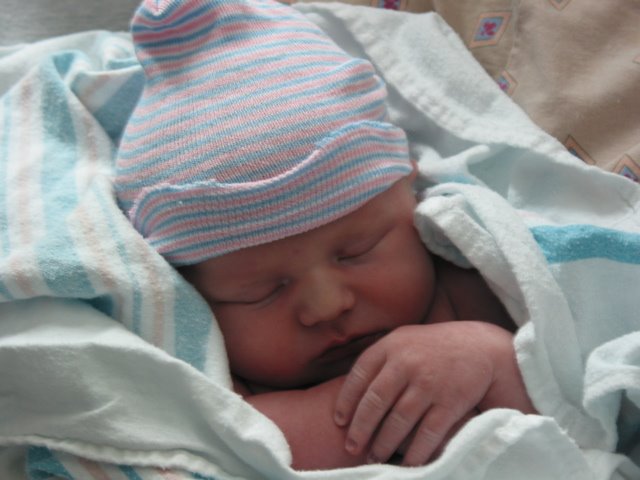
The day before I planned on delivering Prometheus to the printer our little son decided it was time for him to arrive. So, Sunday morning at 6:12am, after three hours in labor, little Aidan Gabriel arrived into our lives. He arrived three weeks early, but healthy and in good spirits. The little boy's mom is exhausted but could not be happier, and the dad needs a little more sleep. I'm now aiming for Wednesday to get the issue to the printer.
Saturday, March 25, 2006
Wrapping up Prometheus
I can't call running around with a three-year old resting, but after last week, that's what today came down to. I spent the evening trying to wrap up the Spring edition of the print newsletter, Prometheus. I am one review away from completing the issue, which I expect to have done by tomorrow night. I'm quite happy with this issue, as I only have two reviews under my byline, and the rest of the issue consists of original essays and reviews. Here a glance at the contents:
Prometheus Award Finalists
Interview with David R. Friedman
Thomas M. Sipos on post-9/11 movies
Richard Mgrdechian on intellectual isolation
Reviews of fiction by David D. Friedman (Harald), Terry Goodkind (Chainfire), Ken MacLeod (Learning the World), Walter Mosley (47), Justina Robson (Silver Screen) , Mike Resnick (Starship: Mutiny), L. Neil Smith (Tom Paine Maru), Charles Stross (The Hidden Family), Michael Z. Williamson (The Weapon), F. Paul Wilson (Harbingers)
News item on Brad Linaweaver’s Mondo Cult
As always, if you're interested in subscribing, or joining LFS, send me an email and I'll mail you a sample issue of Prometheus, free of charge.
Prometheus Award Finalists
Interview with David R. Friedman
Thomas M. Sipos on post-9/11 movies
Richard Mgrdechian on intellectual isolation
Reviews of fiction by David D. Friedman (Harald), Terry Goodkind (Chainfire), Ken MacLeod (Learning the World), Walter Mosley (47), Justina Robson (Silver Screen) , Mike Resnick (Starship: Mutiny), L. Neil Smith (Tom Paine Maru), Charles Stross (The Hidden Family), Michael Z. Williamson (The Weapon), F. Paul Wilson (Harbingers)
News item on Brad Linaweaver’s Mondo Cult
As always, if you're interested in subscribing, or joining LFS, send me an email and I'll mail you a sample issue of Prometheus, free of charge.
Friday, March 24, 2006
B for Betrayal
Forecast: Light and intermittent blogging. No time this week even to read the handful of web pages I visit daily, but this post caught my eye.
William Alan Ritch lashes out at the Wachowskis' verion of V for Vendetta in a commentary he titles, B for Betrayal. Ritch, former editor of Prometheus, argues the Wachowskis "changed [Alan Moore's] point. Its philosophy." I'll break down this commentary more when I actually see the movie, but from my re-reading of the book, Ritch appears 99% spot on in his comparrison of the book and movie.
William Alan Ritch lashes out at the Wachowskis' verion of V for Vendetta in a commentary he titles, B for Betrayal. Ritch, former editor of Prometheus, argues the Wachowskis "changed [Alan Moore's] point. Its philosophy." I'll break down this commentary more when I actually see the movie, but from my re-reading of the book, Ritch appears 99% spot on in his comparrison of the book and movie.
Saturday, March 18, 2006
Robin Guthrie sounds
What can I say, except this is one of quick, personal, not related to the general theme of this blog type of entries. I don't know how long they will be there, but one of my favorite musicians, Robin Guthrie, has put a couple of his tunes on myspace.com. I've never gone to myspace until now, but found the link on Guthrie's blog. Monument, the first tune, is from his forthcoming album, Continental. Lush, wonderful sounds, in the ambient, alternative format. Makes me wish there was an easy, neat way to buy directly from the artist in digital format, rather than wait for the CD or iTunes.
V for Vendetta
If you've seen the movie and want to write a 1000 word review for the Prometheus, let's talk. I think it will be a while before I make it to the movies to see this one, unless I catch a midnight showing some Friday or Saturday a few weeks after the buzz has died down and the place isn't too packed. In the meantime, I've caught a couple of 1/2 hour TV shows about the movie, and looks like Alan Moore is correct about it no longer being his story.
Can't say he's the only writer abused by Hollywood this way. A recent essay by Christopher Buckley in Time magazine's latest edition underscores the hassles of making movies, especially for writers whose works are adapted, or even just optioned. After you've read this, check out www.repairmanjack.com for F. Paul Wilson's ongoing sagas about getting a Repairman Jack movie made, and The Touch as a TV show. Not very encouraging.
Can't say he's the only writer abused by Hollywood this way. A recent essay by Christopher Buckley in Time magazine's latest edition underscores the hassles of making movies, especially for writers whose works are adapted, or even just optioned. After you've read this, check out www.repairmanjack.com for F. Paul Wilson's ongoing sagas about getting a Repairman Jack movie made, and The Touch as a TV show. Not very encouraging.
Friday, March 17, 2006
Prometheus Award finalists
I don't know if there's an embargo on the news, but this is the first posting I've seen out there of the 2006 finalists for the LFS sponsored Prometheus Award, over at Sunni Maravillosa's blog. Scroll down past the yummy mouth-watering images of chocolate to see the list. Here I am, editor of the LFS newsletter, scooped just days after I received the list for the Prometheus Award newsletter... I plan on posting it here over the weekend, but it's been a momentous week in my life, and I'm just too worn out at the moment. Today was my last day at Apple Computer, after 11 years working with the coolest hardware and software on the planet. Okay, so I'm a little biased. I'd keep working there if I could, but small problem: Apple's Texas office is in Austin. I live 90 miles away. The commute for me the last four years has meant two days a week in Austin, three days in my home office, in splendid isolation. On a good day I'm only in the car three hours. It wears on me. I should have changed this scenario a long time ago. The final impetus was the impending arrival of child #2, due any day now. I start work for a local company next week, probably on the not-so-delightful Win XP platform. I have not used Windows since before Win 95. Tough thing for a Gates-hater to have to face.
Regarding the Prometheus Award finalists, I am not on the judges committe. I have not read a single word of the six finalists (and only own one of them, the Ken MacLeod novel). I'm surprised two books I nominated and really liked did not make the cut. Richard Mgrdechian's 3000 Years and Michael L. Wentz' Resurrection of Liberty were books I expected to see as finalists. But, as mentioned, I have not read any of the other works. Walter Mosley is far from being a libertarian, so it will be interesting to read his novel. The Charles Stross novel poses an ethical dilemma for me, as when I read the first book in the series, and realized the publisher took one book, chopped it in half and sold them as two novels, I swore to not give Tor a penny for that second book, despite being captivated by the story. I own of of Stross' other works, and think he's a brilliant writer, but that act by Tor's editors was just immoral, in my eyes. Others may disagree. In January I read not a single work on fiction, but since then I've finished three novels, all of varying quality. My stack of unread books rises like the tower of Babylon.
I'm in the middle of wrapping up the Spring issue of Prometheus, which should be at the printer in less than a week. Twenty pages of reviews and essays. I think it's a great issue, a superb issue.
I just received in the mail a copy of Pyr Books' edtion of Ian McDonald's massive River of Gods. Damn, I need more time in the day. I have five other books that I need to read, and a few reviews to write. And Vernor Vinge's new novel is just around the corner.
Regarding the Prometheus Award finalists, I am not on the judges committe. I have not read a single word of the six finalists (and only own one of them, the Ken MacLeod novel). I'm surprised two books I nominated and really liked did not make the cut. Richard Mgrdechian's 3000 Years and Michael L. Wentz' Resurrection of Liberty were books I expected to see as finalists. But, as mentioned, I have not read any of the other works. Walter Mosley is far from being a libertarian, so it will be interesting to read his novel. The Charles Stross novel poses an ethical dilemma for me, as when I read the first book in the series, and realized the publisher took one book, chopped it in half and sold them as two novels, I swore to not give Tor a penny for that second book, despite being captivated by the story. I own of of Stross' other works, and think he's a brilliant writer, but that act by Tor's editors was just immoral, in my eyes. Others may disagree. In January I read not a single work on fiction, but since then I've finished three novels, all of varying quality. My stack of unread books rises like the tower of Babylon.
I'm in the middle of wrapping up the Spring issue of Prometheus, which should be at the printer in less than a week. Twenty pages of reviews and essays. I think it's a great issue, a superb issue.
I just received in the mail a copy of Pyr Books' edtion of Ian McDonald's massive River of Gods. Damn, I need more time in the day. I have five other books that I need to read, and a few reviews to write. And Vernor Vinge's new novel is just around the corner.
Wednesday, March 08, 2006
David Friedman's Harald
Today I received a review copy by well-known writer of law and economics books, David Friedman. Harald is Friedman's first novel, published by BAEN Books. Set in an imaginary land, the novel is more historical than fantasy, a sort of imagined medieval geography with kings, emperors, and Norse-sounding names. Poul Anderson comes to mind as an inspiration. Friedman's literary style is sparse, at times quite elliptical. I'm only 20 pages into the book, and hope to feature a review (by myself or someone else) in Prometheus, as well a brief interview with Friedman that I received talking about this book. The Spring issue of Prometheus takes shape, and could go 20-24 pages instead of the usual 16.
is Friedman's first novel, published by BAEN Books. Set in an imaginary land, the novel is more historical than fantasy, a sort of imagined medieval geography with kings, emperors, and Norse-sounding names. Poul Anderson comes to mind as an inspiration. Friedman's literary style is sparse, at times quite elliptical. I'm only 20 pages into the book, and hope to feature a review (by myself or someone else) in Prometheus, as well a brief interview with Friedman that I received talking about this book. The Spring issue of Prometheus takes shape, and could go 20-24 pages instead of the usual 16.
Sunday, March 05, 2006
Books received
Below are some review copies that I've received for Prometheus. I'm finally getting around to listing them...
Justina Robson's Silver Screenis a reprint of a novel published in the UK in 1999. Deals with AI rights, weird geniuses, and multi-national intrigue. Review due in the Spring issue of Prometheus.
Mike Resnick's Starship: Mutinya military sf novel, and the first Resnick book I've ever read, a surprising confession as I own several of his books but never opened one before now. This book is sparse and purely action driven, with very little character development. The title foretells the climax of the novel, and it's the first in a five book series. Review due in the Spring issue of Prometheus.
A reprint of a classic sf novel, George Zebrowski's Macrolife: A Mobile Utopia arrived from Pyr books last week. It's been added to the growing stack for the Summer issue.
Keith Brook's novel, Genetopia, received a starred review from Publishers Weekly:
John David's Passion for Dead Leaves. I read the predecessor in this series. Have not yet opened this book. Review due in the Summerissue of Prometheus.
Steven Burgauer's The Last American, another book I won't be able to review until the Summer issue. Have not yet started this one. Been a while since I read one of Burgauer's books.
James P. Hogan's Catastrophes, Chaos & ConvolutionsOkay, I bought this one myself, but I list it here as the review probably won't appear until the Summer issue of Prometheus.
Justina Robson's Silver Screen
is a reprint of a novel published in the UK in 1999. Deals with AI rights, weird geniuses, and multi-national intrigue. Review due in the Spring issue of Prometheus.Mike Resnick's Starship: Mutiny
a military sf novel, and the first Resnick book I've ever read, a surprising confession as I own several of his books but never opened one before now. This book is sparse and purely action driven, with very little character development. The title foretells the climax of the novel, and it's the first in a five book series. Review due in the Spring issue of Prometheus.A reprint of a classic sf novel, George Zebrowski's Macrolife: A Mobile Utopia
arrived from Pyr books last week. It's been added to the growing stack for the Summer issue.Keith Brook's novel, Genetopia
, received a starred review from Publishers Weekly:British author Brooke's engrossing far-future parable intertwines old, old human questions: Who am I? Where am I? Where am I going? Must I go? After centuries of biotechnology gone berserk, "True" humans inhabit a land of mortal fears where a chance microbe or the changing vats of their enemies can dehumanize them forever. "Mutts," grotesque "Lost" subhumans, outwardly devote themselves to their True masters, though like pre–Civil War slaves, the mutts secretly talk of finding "Harmony," freedom from their inborn servitude.Currently on top of the pile for the Summer issue.
John David's Passion for Dead Leaves.
I read the predecessor in this series. Have not yet opened this book. Review due in the Summerissue of Prometheus.Steven Burgauer's The Last American,
another book I won't be able to review until the Summer issue. Have not yet started this one. Been a while since I read one of Burgauer's books.James P. Hogan's Catastrophes, Chaos & Convolutions
Okay, I bought this one myself, but I list it here as the review probably won't appear until the Summer issue of Prometheus.
Walter Mosley, Prometheus Award nominee
I found out this weekend that Walter Mosley's novel, 47, is a Prometheus Award nominee. I believe the final cut of five books is just around the corner, but this is the first time I've heard about the novel. A brief description from Amazon.com (School Library Journal review) goes like this:
I'm hoping to run a review of the novel in the Summer issue of Prometheus, as the Spring issue pretty much is set at the moment, even with an increase in page count to 20.
, is a Prometheus Award nominee. I believe the final cut of five books is just around the corner, but this is the first time I've heard about the novel. A brief description from Amazon.com (School Library Journal review) goes like this:The intense, personal slave narrative of 14-year-old Forty-seven becomes allegorical when a mysterious runaway slave shows up at the Corinthian Plantation. Tall John, who believes there are no masters and no slaves, and who carries a yellow carpet bag of magical healing potions and futuristic devices, is both an inspiration and an enigma. He claims he has crossed galaxies and centuries and arrived by Sun Ship on Earth in 1832 to find the one chosen to continue the fight against the evil Calash. The brutal white overseer and the cruel slave owner are disguised Calash who must be defeated. Tall John inserts himself into Forty-seven's daily life and gradually cedes to him immortality and the power, confidence, and courage to confront the Calash to break the chains of slavery. With confidence, determination, and craft, Tall John becomes Forty-seven's alter ego, challenging him and inspiring him to see beyond slavery and fight for freedom.
I'm hoping to run a review of the novel in the Summer issue of Prometheus, as the Spring issue pretty much is set at the moment, even with an increase in page count to 20.
Thursday, March 02, 2006
Musically geeked out
I just installed SQLTunes on my Mac, which creates a MySQL table from exported tracks from iTunes, and allows me to run reports or even create web pages with interactive options via PHP, should I so choose. I set it up on my local host (if I had access to a remote MySQL db, I'm sure transferring the data would be an easy task), and it felt a lot easier than when I installed SimpleMachines Forum or Moveable Type to see how they worked. Both those apps took a couple of hours of Unix related experimentation on the Mac, but SQLTunes only ran me 15-30 minutes. My first report showed 5715 tracks from 588 artists, although iTunes often incorrectly interprets tracks on classical music CDs - probably more related to the database that iTunes checks, than iTunes itself. For example, there is no artist called "Act I Connais-tu le pays..." but that's how the db assigned a track when ripping the CD. I haven't ripped all my CDs, but this is a great tool for all sorts of reports (count number of songs with same title, for one), and a different perspective on my music library. No idea if the same thing exists in the Windows/Linux world. One strange quirk is that the track_id field, which stamps all the records with a unique ID, started at 39, not one. Another is that the import from the XML file sorted in no logical fashion, except for maybe the "persistent_id" field, which I don't know how populates.
Wednesday, March 01, 2006
Via sf writer Charles Stross' LiveJournal, a list of Tor's new ebooks that will available starting this month. Includes new titles as well as previously paper-published books.
Tuesday, February 28, 2006
TOR sells unencrypted fiction
Via Emerald City, a link to Tor's release about their
new program of selling e-books, oddly enough from competitors BAEN, who pioneered the unencrypted format. Among the authors featured starting in March are Vernor Vinge, Charles Stross, Mercedes Lackey, and Sara Douglass.
new program of selling e-books, oddly enough from competitors BAEN, who pioneered the unencrypted format. Among the authors featured starting in March are Vernor Vinge, Charles Stross, Mercedes Lackey, and Sara Douglass.
Continuing the musical note
I'm recharging my batteries when it comes to books and literary matters, and will post more appropriate stuff soon. In the meantime, an amusing review of an album released today, Trespassers William's Having. The review is more about reaching for flowery prose than the album itself. The band, named after Piglet's grandfather in A.A. Milne's Winnie the Pooh (the scene explaining this is amusing, as the sign to which Piglet alludes is a broken one, which really should read Trespassers Will be Prosecuted), plays quiet, lush music, complemented by vocalist Anna-Lynne Williams soft voice. Preview before you buy, as what I might like now, you might not like ever.
Em, url...
While I didn't jump to a Microsoft site as someone stated happened to them (perhaps because I use a Mac?) when drawing this issue to my attention, I did have a bad link to Eric Raymond's blog on this site. This has been updated to the correct location. People jumping over there will see HRC doing an excellent Hannibal Lecter impersonation, as well as more serious stuff.
Saturday, February 25, 2006
James Hogan moves to Ireland full time
Just spotted this brief note from Wendy McElroy talking about a conversation she had with sf writer James Hogan. Turns out he no longer splits his time between the US and Ireland, but due to the Iraq war has left the US permanently for Ireland. More details at Wendy's site.
Friday, February 24, 2006
Music videos
Sweet heavens! Completely unrelated to the mission of this blog, but wow, some cool music videos over at Silent Sessions by (among others) two of my favorite current bands, Explosions in the Sky and The Album Leaf. Very different types of music, yet both are mainly instrumental. Sadly, I am so far removed from the music scene that I missed both Austin performances, only 90 minutes away. Might be of interest to a future Musical Maundering from Sunni...
U. S. Cartoonists coment on the Danish situation
A nice collection, more a comment on the aftermath than the causes themselves. Via Instapundit.
"Tone down and cover up"
Female Muslim pop singer,Deeyah faces death threats for daring to speak her mind, and also stripping down from burka to bikini in a recent music video, "What Will It Be". This video also shows several men and women with tape over their mouths, a pointed criticism at some repressive trends in many Islamic countries. Forced to leave Norway, where she was born to immigrant parents and started her musical career, she moved to London. There she now experiences the same death threats that forced her to leave the so-called liberal Norway. This FreeMuse site has some interesting articles on women and music censorship, in particular this one, which also can be downloaded as a PDF. View Deeyah's video at this page. Not my kind of music, but still a great statement for the right to free speech and free expression.
Thursday, February 23, 2006
One billion statements of apathy
My long delayed (and brief) response to this story about the apathy of the "download generation" falls on the eve of Apple Computer's announcement that it's sold one billion songs through iTunes. I'm sure they count album tracks individually if sold as such, but I think that's one statement against the study itself. I personally feel the opposite. The ability to download music, to locate tunes not available in record stores, or available at excessive prices at these stores or online at Amazon, has opened up my appreciation for modern music once more.
The survey states (among other things) that "easily accessed tunes mean many music lovers are no longer excited at discovering and playing unfamiliar work." Surely the surveyors have no idea what it means to seek out information. Via iTunes streaming at work, or simply browsing artists and songs and sampling these online, I have discovered a host of artists and records that I never would have found in a regular chain music store. When I attended college in the early 1990s, there was an independent music store near campus. A great place to find unusual stuff. It faded out a few years ago. My tastes in modern music (setting aside classical and jazz for now) veer slightly off the beaten track. I stopped listening to radio years ago, because they played the same few songs every day, and I rarely liked those songs then, let alone now. If not for the download option, I never would have heard of Trespassers William, Devics, Sigur Ros, The Album Leaf, to name a few. I now thrill to discover new music, whereas a few years ago I gave up altogether and focused only on adding to my classical and jazz libraries. With iTunes I can collect the entire Devics discography for under $50 (currently my latest 'new find' band), whereas one early record costs nearly the same amount from Amazon, and cannot be found in chain record stores. CD prices also prevented me from buying much music. A current copy of Harold Budd's minimalist piano recordings costs twice the iTunes price as CD.
No recorded state is safe forever. Digital copies can get lost, but CDs only have a few years of life anyway. Contrary to the people studied, music remains "life-changing and special" to me, and that's due to the birth of download options. One billions downloads later, apathy as a definition now needs to be re-written. The hell with that study.
The survey states (among other things) that "easily accessed tunes mean many music lovers are no longer excited at discovering and playing unfamiliar work." Surely the surveyors have no idea what it means to seek out information. Via iTunes streaming at work, or simply browsing artists and songs and sampling these online, I have discovered a host of artists and records that I never would have found in a regular chain music store. When I attended college in the early 1990s, there was an independent music store near campus. A great place to find unusual stuff. It faded out a few years ago. My tastes in modern music (setting aside classical and jazz for now) veer slightly off the beaten track. I stopped listening to radio years ago, because they played the same few songs every day, and I rarely liked those songs then, let alone now. If not for the download option, I never would have heard of Trespassers William, Devics, Sigur Ros, The Album Leaf, to name a few. I now thrill to discover new music, whereas a few years ago I gave up altogether and focused only on adding to my classical and jazz libraries. With iTunes I can collect the entire Devics discography for under $50 (currently my latest 'new find' band), whereas one early record costs nearly the same amount from Amazon, and cannot be found in chain record stores. CD prices also prevented me from buying much music. A current copy of Harold Budd's minimalist piano recordings costs twice the iTunes price as CD.
No recorded state is safe forever. Digital copies can get lost, but CDs only have a few years of life anyway. Contrary to the people studied, music remains "life-changing and special" to me, and that's due to the birth of download options. One billions downloads later, apathy as a definition now needs to be re-written. The hell with that study.
One billion statements of apathy
My long delayed (and brief) response to this story about the apathy of the "download generation" falls on the eve of
No recorded state is safe forever. Digital copies can get lost, but CDs only have a few years of life anyway. Contrary to the people studied, music remains "life-changing and special" to me, and that's due to the birth of download options. One billions downloads later, apathy as a definition now needs to be re-written. The hell with that study.
No recorded state is safe forever. Digital copies can get lost, but CDs only have a few years of life anyway. Contrary to the people studied, music remains "life-changing and special" to me, and that's due to the birth of download options. One billions downloads later, apathy as a definition now needs to be re-written. The hell with that study.
Tuesday, February 14, 2006
My peeps
Can't say I was too surprised...
Your Ultimate Sci-Fi Profile II: which sci-fi crew would you best fit in?
created with QuizFarm.com
 |
Your Ultimate Sci-Fi Profile II: which sci-fi crew would you best fit in?
created with QuizFarm.com
Wednesday, February 08, 2006
Political Quiz
Not quite your World's Smallest Political Quiz, but rather a satirical quiz to see whether you fall into conservative, liberal, libertarian, or communist camps, with a twist. Don Hagen's Satirical Political Beliefs Assessment Test pokes fun at all four groups. I found myself mostly in the "Antigovernment Libertine" group, though I wasn't sure about #2, and disagreed with the premises for question #10, and too many questions dealt about voting (for this avowed non-voter, at least). Aside from those issues, reading most the answers were a blast, though at times the humor wandered away in the libertarian answers, replaced by what seemed like normal libertarian party platform statements. Total number of questions approaches 200, so some patience is required if you want to read them all.
Tuesday, February 07, 2006
LibriVox
Listened to NPR's The World while driving home tonight and heard an interesting report about LibriVox . The site is a joint effort of volunteers around the world who record chapters of the books in the public domain. The audio files then are published, and can be downloaded or subscribed to as podcasts via iTunes. I plan on making full use of this site, and may even volunteer to read some chapters. I can't say I've listened to that many audio books, but my listening habits while driving to work change all the time, and I might give this a shot.
Saturday, January 28, 2006
Prometheus Award nomination deadline looms
February 15 is the deadline to nominate novels for the 2006 Prometheus Award. Eligible books must have been published for the first time in 2005 (or November/December 2004). If there's such a book should think deserves the Prometheus Award for best novel, please email me at editor AT lfs DOT org.
Thursday, January 26, 2006
Perhaps truth matters
Cynicism takes a blow to the chin? In a follow up to my last post, I need to remark that Oprah changed her mind at long last, and today railed against James Frey for the lies in book. What took so long? Perhaps some backlash and negative comments from her listeners (but not critics and other commentators) convinced her that truth does matter.
Wednesday, January 25, 2006
When the art is more important than truth
Queen Midas poo-poos the controversy surrounding James Frey's (fictional) memoir, A Million Little Pieces. The story came to light recently from the Smoking Gun that Frey's best-selling non-fiction book, propelled to fame from joining Oprah's book club list, and thus converted to gold, contained a few, well, inaccuracies. Oprah calls a few lies "much ado about nothing," citing the powerful message of hope in the book. Quite telling is the fact that Frey "originally tried to sell his book as fiction." When publishers failed to bite, a simple switch to non-fiction was all that it took. Frey's actions have drawn ire from other non-fiction writers, been parodied in the Foxtrot comics, but with Oprah refusing to back down from endorsing the book, appears to have just as much life as lying politicians forgiven again and again by voters and the media.
So, is this really "much ado about nothing?" Two other recent scandals also have surfaced. Fake Navaho writer, Nasdijj won awards for brutally honest portrayals of Native American hardships. JT Leroy, another media darling, appears to be an entirely made up persona created by two writers, using a relative as a front for media appearance. Could this be the tip of the iceberg? Can readers now really trust non-fiction as truth? Memoirs are tricky, as most of the deal with events happens years in the past, usually with little or no verifiable records. And yet, somehow all these pieces need to fit within the constraints of a story. Even if that that story is supposed to be true, the narrative must flow in order to sell and market the book.
If writers at major publications such as The New York Times and The New Republic can manage to sell lies, why not major publishers? In the end the truth does come out, and just as Nixon shook the faith of the American public, and showed that politicians are in general lying crooks, even among those at the top (especially those at the top), these scandals should act as warnings. Be careful of what's packaged and sold. Oprah, that purveyor of populist hope, gives not a fig for thr truth. What's import is the effect of the message, not the content.
As far as this reader goes, truth does matter.
So, is this really "much ado about nothing?" Two other recent scandals also have surfaced. Fake Navaho writer, Nasdijj won awards for brutally honest portrayals of Native American hardships. JT Leroy, another media darling, appears to be an entirely made up persona created by two writers, using a relative as a front for media appearance. Could this be the tip of the iceberg? Can readers now really trust non-fiction as truth? Memoirs are tricky, as most of the deal with events happens years in the past, usually with little or no verifiable records. And yet, somehow all these pieces need to fit within the constraints of a story. Even if that that story is supposed to be true, the narrative must flow in order to sell and market the book.
If writers at major publications such as The New York Times and The New Republic can manage to sell lies, why not major publishers? In the end the truth does come out, and just as Nixon shook the faith of the American public, and showed that politicians are in general lying crooks, even among those at the top (especially those at the top), these scandals should act as warnings. Be careful of what's packaged and sold. Oprah, that purveyor of populist hope, gives not a fig for thr truth. What's import is the effect of the message, not the content.
As far as this reader goes, truth does matter.
Tuesday, January 24, 2006
Call for articles
With the January (slipping into February) issue of Prometheus working through its tortuous process at the printer (I drop it off, show up a couple of days later to approve the pages, and pick it up a few days after that), it's time to think about the next issue of this quarterly newsletter. If you have any reviews, essays, articles dealing with books, movies, music, etc. and liberty, I'm always open to submissions. As an indication of what usually appears, here is a list of the contents of the current issue (each issue runs to about 16 pages):
Reviews of fiction by P. Bagge, Greg Bauder, Scott MacKay, John Meaney, Richard Mgrdechian, Charles Stross, Michael L. Wentz,
and Claire Wolfe & Aaron Zelman;
Review of non-fiction by Ray Kurzweil
Movie review: The Island
Eric S. Raymond on Rudyard Kipling’s SF
Letters; Editorial; Prometheus Award update
Also, if you'd like to subscribe to Prometheus or you're thinking about joining the Libertarian Futurist Society, send me an email at " editor ATMARK lfs DOTMARK org " and I'll mail you a complimentary copy of the newsletter and point you in the right direction to join.
Reviews of fiction by P. Bagge, Greg Bauder, Scott MacKay, John Meaney, Richard Mgrdechian, Charles Stross, Michael L. Wentz,
and Claire Wolfe & Aaron Zelman;
Review of non-fiction by Ray Kurzweil
Movie review: The Island
Eric S. Raymond on Rudyard Kipling’s SF
Letters; Editorial; Prometheus Award update
Also, if you'd like to subscribe to Prometheus or you're thinking about joining the Libertarian Futurist Society, send me an email at " editor ATMARK lfs DOTMARK org " and I'll mail you a complimentary copy of the newsletter and point you in the right direction to join.
Death of creative animations?
Disney buys out Pixar in a 7.4 billion dollar deal. There were rumblings about this for several weeks, and now it appears official. I'm a little wary of this, as Disney really showed little creative output since 1989's The Little Mermaid. Lately they have re-issued updated prints of their classics on DVD, alongside releasing clunkers at the box office. The failures largely suffered from a lack of story, followed by senseless sequels, which has has not been the case over at Pixar. Even their lone sequel, Toy Story II, stood head and shoulders above anything, um, original that Disney produced. Nor have I been impressed with DreamWorks, where all they do is produce re-treaded ideas then sold to the public by over-hyping the names behind the voices. I doubt we would have seen The Incredibles emerge from either Disney or DreamWorks. No new titles had been announced by Pixar beyond this year's Cars, (which originally was slated for 2005 and then pushed back to mid-2006). Still, maybe with a new boss at Disney and John Lasseter still in charge things might be different.
Sunday, January 22, 2006
Brief comments, and a review
After almost four weeks without posting, it seems strange to write again here. I'm breaking a rule about not posting on a borrowed computer, but there's some light ahead in the tunnel of computer despair so I'm taking that silly risk anyway. Looks like a hardware issue brought down my Mac (after fourteen years of using Macs, it's the first time such an event happened), but no indication as to the cause or solution yet. I've let a multitude of posting opportunities go by, and if I write about them now they'll seem dated (though I really do want to address a recent study on music availability and apathy, and list books received for review). Blame at least one week on my first vacation in two years, a brief sojurn in Southern California without any computer access. I decided to give up sodas of all kinds for 2006 (in particular Coca Cola), but I'm not sure if giving up computer access was harder, since I had fewer temptations while away. We hung out near Palm Springs for a couple of days, then drove to San Diego for another three. That latter part was mostly for the three-year-old in the family, and so the days were spent at the zoo, Legoland, and on the beach. This was only my second time in SoCal, and quite unlike Anaheim at the Worldcon in 1996, ten years ago. I had no idea the desert played such a huge role south of LA, nor that San Diego was that hilly, though I can see why people flock to San Diego, as it's a beautiful city. Maybe next time I can hit some of the book stores we spotted along the way.
The good news is that I did manage to restore and complete the January issue of Prometheus, which goes to the printer next week and almost a month behind schedule. This issue contains 16 pages of reviews, letters, fiction, news, and an editorial. For now, here's a brief review as an example.
3000 Years
By Richard Mgrdechian
iUniverse, 2005, $16.95
0-595-36072-6
Reviewed by Anders Monsen
3000 Years is a sharp thriller, one that at times sent my heart racing with excitement and anticipation. Richard Mgrdechian’s first novel blends scientific speculation with elements of the near-future thriller genre. Ostensibly the novel deals with a sort of time-travel, but the underlying focus really deals with human society and how individuals acting in certain, often narrow ways leading to far-reaching implications and unintended consequences.
Professor John Bennett is driven to find ways to cheat death. Motivated by the death of his dog during Bennett’s childhood years, and later his much-admired grandfather, he pours all his energy into physics. He also is a man with many heroes, studding his walls around his punching bag with images of boxing greats like Ali, Dempsey, and Marciano, and his office walls with Einstein, Newton, and other scientists. Bennett’s mood upon discovering a startling new application makes him almost ebullient. By slowing down the speed of light, Bennett is able to place living tissue in a stasis field, preserving youth over great lengths of time. He stands at the cusp of changing the world, granting him instant acclaim and recognition. He’s blessed with admiring students, a wonderful girlfriend—Dawn Whitmore, a cultural anthropologist—and a wide open future at PacTech; all seemingly intended to keep him anchored to the present.
Tom Walsh, the arrogant bureaucratic president of PacTech, despises Bennett for his success. In the aftermath of a bar brawl when Bennett protects one of his star students, Paul Branning, Walsh gets his chance to publicly humiliate Bennett. Yet instead of going down meekly Bennett resigns; he has other plans. He decides to make personal use of his discovery, placing himself into stasis. While the outside world continues along its unabated pace, Bennett will sleep for decades at a time, appearing briefly to witness the progress of history, skipping like a pebble across the river of time. When he finds out that Dawn suffers from incurable ovarian cancer with scant years left, he hatches a plan to place them both in stasis and leap forward until they find a future with a cure. Along for the ride is Sam Tobin, one of Bennett’s old college friends. They fake their deaths and enter stasis in an abandoned missile silo that they bought on the cheap from the government, setting the timer for fifty years in the future.
They arrive into a fragmented America, with California split in several parts, none of which seem enticing or welcoming. They still manage to somewhat adapt themselves into society, with a few mishaps along the way. Bennett secures a visiting professorship at a local college, while Tobin hooks up with Linda Moreno, an attractive attorney after he spends some time in jail for the unpardonable sin of the times, Abhorrent Vocalizations. Speak ill of anything, or have someone find offense in your words, and you end up jail. Farewell free speech. Political correctness runs amuck.
The second act of the novel thus deals with how the trio handles the fifty year leap into the future. Friends and family left behind now are dead, or aged naturally into post-retirement years. Almost alone they face a two-pronged threat: how can they integrate themselves—even temporarily—into a culture of fear and social repression, and also deal with an escalating threat of nanotech hackers bent on tearing apart integral communications technologies?
In their new world, the trio seeks others of like minds, from Sam’s attorney friend, to a student (who later proves false), and another professor that Bennett meets at his new university. Against the latter they team up with a former hacker, Harold Fu, who immigrated to America from China on the advice of his brother.
With Harold along for the ride, the novel takes on a thriller aspect, as they race to locate the nano-hackers, only to discover a ghost from Bennett’s past. Can they defeat this threat, and is there a chance of saving Dawn from her cancer? Indeed, the effects of the statis appear only to have accelerated her illness, and instead of a possible cure, time grows ever shorter, with another stasis trip seemingly impossible, even fatal. The twist thrown in here certainly highlights how deep-reaching a simple event can become, even decades after the cause.
Some of the secondary characters encountered in the novel receive short treatments. I expected more about the young boy, Tommy Vesely, who Bennett befriends as a fellow science fan. The swift transformation of Tinny Morrison, from flirtatious student to predatory troublemaker, took me by surprise, but played out well in showing the interplay between Bennett and Dawn. It also makes for one of the more interesting scenes in the book, in the virtual global “mood-bar.” Linda Moreno, the attorney who latches onto Sam, also is dropped later in the book, but not before she walks us through some of the stranger new legal aspects of this society.
Despite these few misgvings Richard Mgrdechian succeeds in writing a convincing thriller rooted in present day technological, social, and legal trends. Blending moments of fast-paced narrative with occasional and brief info-dumps, Mgrdechian crafts an enjoyable work that I believe many libertarians and futurists will enjoy. In fact, I felt many of the chapters were too brief, leaving some threads unfulfilled. I felt the title of the novel to be a little misleading, although the novel certainly leaves open the possibilities for sequels. However, writing about how present day people deal with events fifty years in the future probably is quite different from one hundred or one thousand, but not altogether impossible.
http://www.3000years.org/
The good news is that I did manage to restore and complete the January issue of Prometheus, which goes to the printer next week and almost a month behind schedule. This issue contains 16 pages of reviews, letters, fiction, news, and an editorial. For now, here's a brief review as an example.
3000 Years
By Richard Mgrdechian
iUniverse, 2005, $16.95
0-595-36072-6
Reviewed by Anders Monsen
3000 Years is a sharp thriller, one that at times sent my heart racing with excitement and anticipation. Richard Mgrdechian’s first novel blends scientific speculation with elements of the near-future thriller genre. Ostensibly the novel deals with a sort of time-travel, but the underlying focus really deals with human society and how individuals acting in certain, often narrow ways leading to far-reaching implications and unintended consequences.
Professor John Bennett is driven to find ways to cheat death. Motivated by the death of his dog during Bennett’s childhood years, and later his much-admired grandfather, he pours all his energy into physics. He also is a man with many heroes, studding his walls around his punching bag with images of boxing greats like Ali, Dempsey, and Marciano, and his office walls with Einstein, Newton, and other scientists. Bennett’s mood upon discovering a startling new application makes him almost ebullient. By slowing down the speed of light, Bennett is able to place living tissue in a stasis field, preserving youth over great lengths of time. He stands at the cusp of changing the world, granting him instant acclaim and recognition. He’s blessed with admiring students, a wonderful girlfriend—Dawn Whitmore, a cultural anthropologist—and a wide open future at PacTech; all seemingly intended to keep him anchored to the present.
Tom Walsh, the arrogant bureaucratic president of PacTech, despises Bennett for his success. In the aftermath of a bar brawl when Bennett protects one of his star students, Paul Branning, Walsh gets his chance to publicly humiliate Bennett. Yet instead of going down meekly Bennett resigns; he has other plans. He decides to make personal use of his discovery, placing himself into stasis. While the outside world continues along its unabated pace, Bennett will sleep for decades at a time, appearing briefly to witness the progress of history, skipping like a pebble across the river of time. When he finds out that Dawn suffers from incurable ovarian cancer with scant years left, he hatches a plan to place them both in stasis and leap forward until they find a future with a cure. Along for the ride is Sam Tobin, one of Bennett’s old college friends. They fake their deaths and enter stasis in an abandoned missile silo that they bought on the cheap from the government, setting the timer for fifty years in the future.
They arrive into a fragmented America, with California split in several parts, none of which seem enticing or welcoming. They still manage to somewhat adapt themselves into society, with a few mishaps along the way. Bennett secures a visiting professorship at a local college, while Tobin hooks up with Linda Moreno, an attractive attorney after he spends some time in jail for the unpardonable sin of the times, Abhorrent Vocalizations. Speak ill of anything, or have someone find offense in your words, and you end up jail. Farewell free speech. Political correctness runs amuck.
The second act of the novel thus deals with how the trio handles the fifty year leap into the future. Friends and family left behind now are dead, or aged naturally into post-retirement years. Almost alone they face a two-pronged threat: how can they integrate themselves—even temporarily—into a culture of fear and social repression, and also deal with an escalating threat of nanotech hackers bent on tearing apart integral communications technologies?
In their new world, the trio seeks others of like minds, from Sam’s attorney friend, to a student (who later proves false), and another professor that Bennett meets at his new university. Against the latter they team up with a former hacker, Harold Fu, who immigrated to America from China on the advice of his brother.
With Harold along for the ride, the novel takes on a thriller aspect, as they race to locate the nano-hackers, only to discover a ghost from Bennett’s past. Can they defeat this threat, and is there a chance of saving Dawn from her cancer? Indeed, the effects of the statis appear only to have accelerated her illness, and instead of a possible cure, time grows ever shorter, with another stasis trip seemingly impossible, even fatal. The twist thrown in here certainly highlights how deep-reaching a simple event can become, even decades after the cause.
Some of the secondary characters encountered in the novel receive short treatments. I expected more about the young boy, Tommy Vesely, who Bennett befriends as a fellow science fan. The swift transformation of Tinny Morrison, from flirtatious student to predatory troublemaker, took me by surprise, but played out well in showing the interplay between Bennett and Dawn. It also makes for one of the more interesting scenes in the book, in the virtual global “mood-bar.” Linda Moreno, the attorney who latches onto Sam, also is dropped later in the book, but not before she walks us through some of the stranger new legal aspects of this society.
Despite these few misgvings Richard Mgrdechian succeeds in writing a convincing thriller rooted in present day technological, social, and legal trends. Blending moments of fast-paced narrative with occasional and brief info-dumps, Mgrdechian crafts an enjoyable work that I believe many libertarians and futurists will enjoy. In fact, I felt many of the chapters were too brief, leaving some threads unfulfilled. I felt the title of the novel to be a little misleading, although the novel certainly leaves open the possibilities for sequels. However, writing about how present day people deal with events fifty years in the future probably is quite different from one hundred or one thousand, but not altogether impossible.
http://www.3000years.org/
Thursday, January 19, 2006
Why We Fight
Why We Fight may well become one of the most interesting and controversial documentaries of 2006. The trailer itself is a chilling insight into the current state of the growth of the American war machine. The website advertises the movies as "a bipartisan inquiry into the workings of the military industrial complex and the rise of the American Empire." I did detect a focus on profit as the main motive, but sure there is more that this at work.
Saturday, December 31, 2005
Adrift off the sea of OS X
This weekend I suffered not one but two apparent computer deaths. The most critical is that main system, where I have all my 2005 documents and all my issues of Prometheus, including the oh-so-nearly completed January issue. Backed-up? Not really. I had used my old external harddrive to back up another system that I recently migrated to OS X Tiger, and this drive was full. As hard drives continue to grow in size, I failed to keep up, and now I need to spend a couple of hundred bucks on a 200G external drive, hope my machine can get fixed, and make sure to schedule daily backups. My secondary system, now ca. five years hold, was pulled into duty, but today also failed. So far I have made no headway in bringing either machine back to life, and so I'm using a third option, my trusty PowerBook from work. I have to hope it makes it through the last minutes of 2005 without crapping out. Offers have been made to certain computer gods, but these are notoriously fickle.
All this means that the January issue of the Prometheus newsletter, instead of going to the printer next week, is at least a week delayed, and the four reviews I wrote last week will not be posted to this blog as planned, until I know I can get the data back. Worst case scenario means installing In Design on a borrowed machine and writing all the reviews again from scratch, which means at least a month's delay or more, something to which I do not look forward.
Mood: Grim.
All this means that the January issue of the Prometheus newsletter, instead of going to the printer next week, is at least a week delayed, and the four reviews I wrote last week will not be posted to this blog as planned, until I know I can get the data back. Worst case scenario means installing In Design on a borrowed machine and writing all the reviews again from scratch, which means at least a month's delay or more, something to which I do not look forward.
Mood: Grim.
Sunday, December 25, 2005
Harald by David Friedman
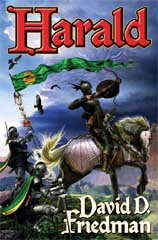
Harald is the debut fantasy novel from David Friedman, libertarian writer and author of The Machinery of Freedom. You can read an excerpt at BAEN Books, publishers of the hardcover edition, due April 2006.
Thursday, December 22, 2005
Adventurous fantasy/sf
I just finished reading a new novel from Scott Mackay, called Tides. Longer review completed and forthcoming in the January edition of Prometheus. This book details the adventures of a mariner driven to sail the vast and treacherous seas that surround his homeworld, in search of a possible other continent. A rollicking sea-tale that also examines clashing cultures, and questions the status quo of an apparent peaceful yet corrupt society.
Longer review completed and forthcoming in the January edition of Prometheus. This book details the adventures of a mariner driven to sail the vast and treacherous seas that surround his homeworld, in search of a possible other continent. A rollicking sea-tale that also examines clashing cultures, and questions the status quo of an apparent peaceful yet corrupt society.
In the mail
I received a copy of the American edition of Justina Robson's Silver Screen. Alas, the UK cover looks far cooler than the Pyr edition. I've just started the book, with plans to review it in neither the January or April edition of Prometheus. So far I am very impressed by the story and writing.
I've just started the book, with plans to review it in neither the January or April edition of Prometheus. So far I am very impressed by the story and writing.
Writer fined for 'Turkish insult'
Another writer fined for Turkish insult against the state. Zulkuf Kisanak's novel describes the forced evacuation of Turkish Kurds from their villages. How can Turkey expect to join the EU with these illiberal laws?
Resurrection of Liberty
I'm working on a long review for Prometheus, but if you like adventurous science fiction that takes you back to the days of Robert A. Heinlein, Michael L. Wentz's novelResurrection of Liberty is on sale for under $20. I really enjoyed this book, and highly recommend it. It's hard to beat this price for a nicely bound hardcover book, and would make a great gift to youngsters and adults alike.
Wednesday, December 21, 2005
L. Neil Smith's movie treat(ment)
Over the Libertarian Enterprise, novelist and Prometheus Award winner L. Neil Smith shares a movie treatment he wrote called TimePeeper. Written in the 1980s, it's an interesting addition to Smith's North American Confederacy universe.
Monday, December 19, 2005
Master and Margarita to debut as TV movie in Russia
The New York Times writes about a nearly nine hour TV movie version of a superb Russian novel, Mikhail Bulgakov's Master and Margarita. "For the Soviet or Russian person, meeting with Bulgakov's novel in 1966 was a taste of freedom," states the director. The book can be read on many levels, one of which details how people "disappear" into the basements of the KGB. Other elements are more fantastic, such as the Devil setting up shop in Moscow. The novel is a hallmark of wit and elebance, but devilishly difficult to adapt to the screen. I seriously hope this gats translated and shown outside Russia one day.
Thursday, December 15, 2005
Turkish novelist on trial for speech
I heard about the case of Orhan Pamuk's trial on NPR driving home today. The trial begins on December 16. Here is a country's most famous novelist on trial for saying something that insults the national character. Apparently, by discussing the verboten subject of over one million alleged Armenian deaths in Turkey in 1915, Pamuk stepped on the toes of Turkish national honor. It's a shame that so many of his countryfolk hate him for daring to speak his mind, but Turkish children are taught at an early age to venerate all things Turkish, and that means no criticism of the government view. Whether or not one million Armenians died should be investigated fully, not swept under the carpet.
Tuesday, December 13, 2005
V for Vendetta teaser

Wally Conger passes on some positive comments from a pre-screening report of V for Vendatta in Austin, Texas recently. Interestingly, the guys at Ain't It Cool News, which posted the comments, wrote early on about disturbing changes to the script. Either the movie changed, or the opinions did, but regardless this does appear positive. The posters are superb.
Monday, December 12, 2005
I'll buy one of these
The death of book publishing? Perhaps. Certainly the device mentioned in this article makes the case well, and merges more than just a book reader into the package. Imagine curling up on a sofa reading a favorite author while listening to music from the same small gadget. Oh yeah!
Historical fiction and liberty
Edward Cline's Sparrowhawk books seem like a compelling series. Book five now available via Laissez Faire Books.
Sunday, December 11, 2005
Can't wait
F. Paul Wilson's new Repairman Jack novel, Harbingers, inches closer to publication. Gauntlet Press released a teaser page with the book cover, a stunning work of art. They begin taking orders on January 1, 2006, and their limited edition probably will sell out before the publication date of June. Mass market hardcover follows later in the year, but hard-core fans will want their copy early.
Wednesday, December 07, 2005
Regional literature
Over at lewrockwell.com, a libertarian site that also at times embraces confederacy southron culture and its implied racism and agrarian aristocracy, Gail Jarvis present a Christmas list of southern American fiction.
Meanwhile, a different sort of culture emerges in Tom Palmer's reading of Ole Edvart Rølvaag’s novel Giants of the Earth. According to Palmer, Giants in the Earth "is about accomplishment, rivalry (of various sorts), the joy of productive work, family, love, religion, common sense, and, above all else, striving."
All this is a far cry from the so-called Southern scenario, where on a frivolous level "beautiful women [are] eagerly sought after by men," and "young Southern aristocrats [try] to win the affection of their true loves during Charleston’s holiday season." Also discussed are more serious issues in the "agrarian South" of " conflicts arising when urbanism creeps into rural communities," and where there are "strange yet kindly master[s]."
Both Rølvang and the southern authors mentioned by Jarvis deal with non-urban settings, but in terms of cultural ideas it seems you have to look to a Norwegian to express the ideas of true American values. Jarvis fails to mention my all-time favorite novel, and a book written by a person from the south Harper Lee's To Kill a Mockingbird. Perhaps this book is too famous, or contains the wrong values, as Jarvis seeks to highlight works that "avoid the stereotypical Hollywood clichés about the region."
Meanwhile, a different sort of culture emerges in Tom Palmer's reading of Ole Edvart Rølvaag’s novel Giants of the Earth. According to Palmer, Giants in the Earth "is about accomplishment, rivalry (of various sorts), the joy of productive work, family, love, religion, common sense, and, above all else, striving."
All this is a far cry from the so-called Southern scenario, where on a frivolous level "beautiful women [are] eagerly sought after by men," and "young Southern aristocrats [try] to win the affection of their true loves during Charleston’s holiday season." Also discussed are more serious issues in the "agrarian South" of " conflicts arising when urbanism creeps into rural communities," and where there are "strange yet kindly master[s]."
Both Rølvang and the southern authors mentioned by Jarvis deal with non-urban settings, but in terms of cultural ideas it seems you have to look to a Norwegian to express the ideas of true American values. Jarvis fails to mention my all-time favorite novel, and a book written by a person from the south Harper Lee's To Kill a Mockingbird. Perhaps this book is too famous, or contains the wrong values, as Jarvis seeks to highlight works that "avoid the stereotypical Hollywood clichés about the region."
Catastrophes, Chaos & Convolutions
Available now, the latest James Hogan collection. I'm hoping to review this in the January edition of Prometheus, but I'm behind already on writing some other reviews, so it might be later.
. I'm hoping to review this in the January edition of Prometheus, but I'm behind already on writing some other reviews, so it might be later.
Friday, December 02, 2005
Rudyard Kipling Invented SF!
Eric S. Raymond is spurred to further reading on Kipling by a comment on his essay that I reprinted in Prometheus. I have to admit that it's been a long time since I read Kipling, and then it mostly was his Indian tales. I've pulled down my Kipling sf collection and hope to read the stories again, given the comments by both Raymond and William Stoddard, who caused Raymond to re-think some of the ideas in his original essay.
Wednesday, November 30, 2005
Calling card
I'm travelling this week, hence the lack of posts. I had hoped to post a couple of book reviews, but these are still in process. In the meantime, as I'm sorting through my luggage preparing for my return flight, I notice a strange card. It appears the Transportation Security Aministration's minions opened my checked in luggage, pawed through the contents, and left me a card explaining what they did. There's no indication why, although I did put part of my keychain in this bag, since it includes a tiny Swiss Army knife, and I did not want it confiscated. Next time I'll leave that implement in the car, and carry the extra luggage on the plane. And I used to like airports and flying. No more. I'm tired of the long lines, the bored yet superior attitude of the screeners, and the waste and fraud the accompany any federalized operation.
Monday, November 28, 2005
Ayn Rand and sf
Roderick T. Long relates a personal search for an elusive memory of an article on Ayn Rand and science fiction in an old issue of Starlog. The issue in question, #22, May 1979 contains an article on the science fiction of Ayn Rand, especially Anthem and Atlas Shrugged, and includes a Boris Vallejo painting of the John Galt torture scene from the latter novel. The link in Long's article about a movie adaptation of Anthem takes the surfer to an article from early 2004. Posted by Rand scholar Chris Sciabarra this story talks about former Starlog publisher Kerry O'Quinn acquiring the movie rights to Anthem. I personally think the book would better be adapted as a graphic novel or animated movie, filmed purely in black and white. Still, Rand fans whose interest is piqued by this story may drive the price of that 26 year old issue of Starlog.
Tuesday, November 22, 2005
Book received: John Meaney

Next week I'm hoping to complete three long book reviews for Prometheus, the newsletter that I edit. Lo and behold, Pyr books drops a large, heavy volume at my doorstep, which I look forward to reading but will have to wait until those prior obligations are finished. John Meaney's Context
looks quite interesting. In interview at SF Site from 2002, conducted by Lou Anders, British sf writer Meaney talks about his novel. There's a dark force rising throughout Nulapeiron, known as the Blight, or the Dark Fire. It subsumes human beings, makes them insignificant components of a vast whole: an entity which bears the same relationship to a single human being as a person does to a bacterium. From small beginnings, realms undergo strange societal changes, until they become part of the Blight-occupied territories.
The US publication date is 2005. It's book two of a series, but the author promises each will work as a stand-alone book. Fantastic over painting by Jim Burns. More to follow...
Harry Potter and the Half-Crazed Bureaucracy
Via Liberty and Power, a link to an abstract of an essay by Benjamin Barton on the implied libertarian critique of government in J. K. Rowling's Harry Potter novels.
I ventured reluctantly into the world on Harry Potter only after the third novel saw publication in paperback, but I quickly became a fan. The seven-novel saga (one book remains to be written) sketches a rich world as young Harry grows to adulthood, cursed to be different in many ways. He's a wizard, an orphan, abused by his adoptive family, feared and misunderstood by fellow wizards, and fated to face the most dangerous wizard ever born. I noticed early on the strong antipathy towards government and its minions in Rowling's books, especially book five. Yet also the man-hunt for Sirius Black and revelations into the way the Ministry of Magic dealt with wizards after Voldemort's "death" highlighted the corruption of those in power. Several of Voldemort's allies received government positions, influencing the direction of the Ministry. For an alleged children's series, Harry Potter is layered with multiple meanings far beyond the perceptions of a young audience. Rowling writes with this in mind, resulting in the series' popularity with adults as well.
The critique is even more devastating because the governmental actors and actions in the book look and feel so authentic and familiar. Cornelius Fudge, the original Minister of Magic, perfectly fits our notion of a bumbling politician just trying to hang onto his job. Delores Umbridge is the classic small-minded bureaucrat who only cares about rules, discipline, and her own power. Rufus Scrimgeour is a George Bush-like war leader, inspiring confidence through his steely resolve. The Ministry itself is made up of various sub-ministries with goofy names (e.g., The Goblin Liaison Office or the Ludicrous Patents Office) enforcing silly sounding regulations (e.g., The Decree for the Treatment of Non-Wizard Part-Humans or The Decree for the Reasonable Restriction of Underage Sorcery). These descriptions of government jibe with our own sarcastic views of bureaucracy and bureaucrats: bureaucrats tend to be amusing characters that propagate and enforce laws of limited utility with unwieldy names. When you combine the light-hearted satire with the above list of government activities, however, Rowling's critique of government becomes substantially darker and more powerful.
I ventured reluctantly into the world on Harry Potter only after the third novel saw publication in paperback, but I quickly became a fan. The seven-novel saga (one book remains to be written) sketches a rich world as young Harry grows to adulthood, cursed to be different in many ways. He's a wizard, an orphan, abused by his adoptive family, feared and misunderstood by fellow wizards, and fated to face the most dangerous wizard ever born. I noticed early on the strong antipathy towards government and its minions in Rowling's books, especially book five. Yet also the man-hunt for Sirius Black and revelations into the way the Ministry of Magic dealt with wizards after Voldemort's "death" highlighted the corruption of those in power. Several of Voldemort's allies received government positions, influencing the direction of the Ministry. For an alleged children's series, Harry Potter is layered with multiple meanings far beyond the perceptions of a young audience. Rowling writes with this in mind, resulting in the series' popularity with adults as well.
Thursday, November 17, 2005
The Prisoner 'set for TV return'
BBC reports that Sky One is planning a new series inspired by the Prisoner. Although the themes of conspiracy and paranoia will remain, the setting will differ, and the show would take other "liberties" with the original. In 2002 the Libertarian Futurist Society recognized The Prisoner with a Prometheus Award for a classic work of liberty. The entire 17 show series is available in a nicely packaged DVD set.
Wednesday, November 16, 2005
More reasons to avoid Sony CDs
This story adds a level to Sony's sly metthod of loading various DRM software on user PC. All this focus on Sony does make me wonder what other companies are up to? Lately all the discussion has been about piracy and methods to protect intellectual rights, but subverting the customer's computer system seems like a risky path, in my opinion. There are legal implications in Sony's method, but more importantly, your computer and privacy end up compromised. The key is to simply avoid all infected CDs. Quarantine them. Ignore them. This won't be the last we hear from Sony, nor the last attempt at intrusive DRM in CDs and DVDs.
Sunday, November 13, 2005
Infected Sony CDs
From EFF, a list of Sony CDs with draconian copy protection keyed to infect and in some cases disable your computer (and liberty). Good thing none of these bands are on my list, but in addition, some photos of how to detect these CDs, and also how to disable the XCP software.
Friday, November 11, 2005
Vernor Vinge on Accelerating Change
Vinge's keynote address from Accelerating Change 2005 is available as an MP3 download. Recorded 9/17/05, the speech runs around 40 minutes. Very interesting stuff, and quite timely in terms of my discovery of this, as I'm currently working on a review of Ray Kurtzweil's non-fiction book, The Singularity is Near.
.
RebelFire review
Chris Hibbert reviews Prometheus Award nominated novel, RebelFire: Out of the Gray Zone. Perhaps too many spoilers in the second-to-last paragraph, but overall a positive review.
Jumper adapted for screen
Sci Fi Wire reports on the announcement that Steve Gould's novel, Jumper, will be adapted for the big screen. "Fight Club writer Jim Uhls will rewrite a script by David S. Goyer (TV's Threshold). Production will begin in the spring."
Malware taking advantage of Sony DRM
Indeed. This did not take long. Sony rootkit tehcnology opens the door to hackers.
Sony reaches out to Macs with DRM?
In a previous post I mentioned the DRM that Sony installs on Windows PC. Now it appears Sony CDs also account for Mac OS X and installs some form of copy-protection. Now, I'm against piracy, but this move is not the right way to go, in my opinion.
Wednesday, November 09, 2005
Movie-plexes as minions of the MPAA
Via Claire Wolfe's blog, a link to a story about MPAA thuggery at a movie-plex. The author seems to think "movie studios are losing revenue because of the increasingly poor movie-going experience and general low-quality of the movies they are making." Perhaps. In my case, I hate rude fellow patrons, and inevitably I have people right behind me talking through the movie. That makes me prefer viewing a DVD at home. The last movie I saw, Wallace & Gromit and the Curse of the Were-Rabbit, was a matinee. As the lights dimmed, I seemed to be the only person in the theatre. But then, a moment later, two older women hobble in, both talking. They proceeded to talk through-out the entire movie, despite loud comments and muttered curses from me, thereby ruining the movie. Yes, I probably could have alerted the manager, but would that have stopped them/ probably only for a few minutes, and I would have lost screen-time in the time it would have taken to find a person. No, I prefer to watch the movie on my own time, at home, although the screen is smaller, and I have to keep the volume down to not wake the infant.
Monday, November 07, 2005
Nefarious Sony deserves boycott
From CNET News, an article about SonyBMG loading spyware on your PC. Turns out some copy protected CDs, such as Van Zant's Get Right with the Man, will implant a copy-prevention utility on your Windows PC. I use a Mac, but just the same, once you buy a CD you should be able to copy this for you own use without any restrictions. Amazon does warn buyers: [CONTENT/COPY-PROTECTED CD]. I'm going to think twice before purchasing any SongBMG product from now on.
Sunday, November 06, 2005
The only Bush I like
Chalk this entry under Personal, of little interest to liberty per se. Kate Bush releases Aerial, her first new album in 12 years. A noted perfectionist, Bush released the album on her own schedule, and bowed to no one. She's a far cry from manufactured artists and media vampires. Three cheers from this fan.
Tuesday, November 01, 2005
2006 - the year of Vernor Vinge?
Not only will sf writer Vernor Vinge's latest novel appear in early 2006, but at least one of his long out of print books will see light again. Tatja Grimm's World appears on Tor's schedule for January, 2006 with a gorgeous cover. (I tried uploading just the cover but ran into Blogger errors, so here's the closest thing I could manage.)
appears on Tor's schedule for January, 2006 with a gorgeous cover. (I tried uploading just the cover but ran into Blogger errors, so here's the closest thing I could manage.)Monday, October 31, 2005
LRC Bestseller List - two Prometheus Award nominees
The Lew Rockwell Center posts a bestseller list compiled from Amazon.com referral sales, and two Prometheus Award nominated novels made the list. A third novel, John Twelve Hawks' The Traveler, was reviewed in the Fall 2005 issue of Prometheus. The two Prometheus Award nominees? Claire Wolfe and Aaron Zelman's Rebelfire at No. 3, and Vin Suprynowicz's The Black Arrow at No. 13. (See list below for current list of nominees.)
was reviewed in the Fall 2005 issue of Prometheus. The two Prometheus Award nominees? Claire Wolfe and Aaron Zelman's Rebelfire at No. 3, and Vin Suprynowicz's The Black Arrow at No. 13. (See list below for current list of nominees.)
Sunday, October 30, 2005
I Must Speak Out now online
Since 1986 I have subscribed to Carl Watner's The Voluntaryist. I own every published issue of this fine publication, which I find to be the most consistent form of libertarianism ever expressed. A short while ago Watner published a "best of" book entitled I Must Speak Out, an anthology containing 70 essays from the first 100 issues. This book now is available online as a free PDF download. I highly recommend spending a few minutes of your time reading this book. You might agree or disagree with the premises and conclusions of Voluntaryism, yet also I believe you'll be intellectually challenged.
Thursday, October 27, 2005
Right wing movies
Previously I mentioned the Liberty Film Festival. Jesse Walker of Reason magazine actually attended the events, and details his experiences here. As I expected, rather than deal with pro-liberty issues, Hollywood's Conservative Film Festival (as it called itself) is more about taking on the left, especially Michael Moore and anti-war ideas. As Walker muses, "If these movies represent contemporary conservatism, then conservatism today has little room for libertarian ideas." An excellent article that covers many of the films from the festival.
Death Is Easy - novel
From Russel Madden, a detective story set in a world where liberty is taken for granted. Yet, "Even in a fully free society danger abounds." The novel is published through Lulu, which was founded by Bob Young, co-founder of open source company Red Hat, and touts itself as "the web's premier independent publishing marketplace for digital do-it-yourselfers." Death is Easy is available as print paperback and download, with a 51 page PDF preview. Support libertarian fiction and check it out.
Preliminary 2006 Prometheus Award nominees
Two writers have already made mention of their book being nominated for the 2006 Prometheus Award. Below is a preliminary list of the current nominees. Additional books are still being considered, and in early 2006 this list will be whittled down by a judges panel to five finalists. As of August 25, eight novels have been nominated for the 2006 Best Novel category. This is by no means the final list, but since I printed this list in the fall issue of Prometheus, I wanted to make it available online as well, with links to Amazon for those who wish to buy (or read more about) the books.
Chainfire, by Terry Goodkind (TOR Books)
Reflex, by Stephen Gould (TOR Books)
Noble Vision, by Gen LaGreca (Winged Victory Press)
The Black Arrow, by Vin Suprynowicz (Mountain Media)
Accelerando, by Charles Stross (Ace/Putnam Books)
Infernal, by F. Paul Wilson (Forge Books)
RebelFire: Out of the Gray Zone, by Claire Wolfe & Aaron Zelman (RebelFirePress)
The Mists of Everness, by John C. Wright (TOR Books)
Chainfire
, by Terry Goodkind (TOR Books)Reflex
, by Stephen Gould (TOR Books)Noble Vision
, by Gen LaGreca (Winged Victory Press)The Black Arrow
, by Vin Suprynowicz (Mountain Media)Accelerando
, by Charles Stross (Ace/Putnam Books)Infernal
, by F. Paul Wilson (Forge Books)RebelFire: Out of the Gray Zone
, by Claire Wolfe & Aaron Zelman (RebelFirePress)The Mists of Everness
, by John C. Wright (TOR Books)
Tuesday, October 25, 2005
RIP Originality in the Movies
Sad news about more regurgitated retreads. A four 'page' store from ABC News on sequelitis in Hollywood, throwing in the opening tidbit that Sylvester Stallone's last three movies all were Direct to DVD dreck like Avenging Angelo, Shade and D-Tox (originally titled Eye On You). A far cry from inspiring Henry Winkler's Fonzie in The Lords of Flatbush, and the original "Rocky" and "Rambo" movies. Old Sly is far from alone, as in the bottom-line corner, weighing in at there-must-be-profits-here-somewhere, we find planned sequels to Die Hard, Terminator, Basic Instinct and Indiana Jones. Now three of these are "IV," and Basic Instinct only looks ahead to number two, but come on. Hasn't the story in each case been told enough? Move on to something new. There's still great original unfilmed books out there, but we see are sequels and re-makes. How about Probability Broach, the movie? Or The Stress of Her Regard? Two very different yet quite worthy ideas, and the latter even has vampires! As always, the lure of money trumps any statement by former stars to never appear in sequels. And enough people will rent or buy the DVDs to make them profitable, so get ready for a whole host of remakes and sequels for a very long time.
Wednesday, October 19, 2005
From the ashes of iFeminsts
Wendy McElroy shuts down one forum and launches another, broader forum. Some of the topics of interest include "Entertainment," which is sure to bring up books and movies related to liberty.
Chinese anarchist writer
Via Liberty and Power.
An enticing obituary of Ba Jin, dead at the age of 100, who once wrote "Never for a moment will I put down my pen. It is kindling a fire within me." Taking his name from Bakunin and Kropotkin, Ba Jin fell victim to the Cultural Revolution, of which he said, "Where else have authors in the world throughout history gone through something so terrifying and ridiculous, so bizarre and agonizing?" There's a ripe history barely hinted at in this article, that I hope some modern Chinese anarchists will pick up and publish.
An enticing obituary of Ba Jin, dead at the age of 100, who once wrote "Never for a moment will I put down my pen. It is kindling a fire within me." Taking his name from Bakunin and Kropotkin, Ba Jin fell victim to the Cultural Revolution, of which he said, "Where else have authors in the world throughout history gone through something so terrifying and ridiculous, so bizarre and agonizing?" There's a ripe history barely hinted at in this article, that I hope some modern Chinese anarchists will pick up and publish.
Tuesday, October 18, 2005
Karl Hess Club blog
J. Neil Schulman Thomas M. Sipos have started blog based on the log-running Karl Hess Club dinner discussions (see link to the right on this page). So far the most interesting post (in my opinion) dealt with copyright.
Monday, October 17, 2005
Linaweaver's Der Krapp columns online
Under the premise of finding something good to say about the worst movies ever made, Brad Linaweaver penned 17 entries under the column name "Der Krapp." Now online at Big Lizards, this is sure to feed some Netflix queues. Or not.
Saturday, October 15, 2005
Announcing Roswell, Texas
Scott Bieser posts hot news about L. Neil Smith and Rex F. May's new novel, Roswell, Texas, to be published as a graphic novel as web-installments, and possibly a print version if there's enough market demand. The premise certainly is enticing...
Imagine a world in which Texas never joined the United States, NAZI Germany conquered England but was held in check by a nuclear-armed Irish Republican Army, the Catholic Church has moved its headquarters to Brownsville, Texas, and Mexico is ruled by a neo-Aztec emperor in partnership with French colonial bureaucrats-in-exile.
In this Texas-that-might-have-been, residents are required to have permits not to carry firearms. The Federated States of Texas includes most of what we know as New Mexico and Colorado, as well as Louisiana, Arkansas, Oklahoma, Kansas, parts of Wyoming, Nebraska, and Missouri. Not to mention Alaska, Cuba, Venezuela, most of Central America, and the Phillippines. Its currency is based on petroleum, and its limited government is financed entirely by a monopoly on garbage collection.
And in 1947, Texican President Charles A. Lindbergh was faced with a most amazing, and potentially world-changing, situation — reports of a flying saucer crash in far west Texas, near the town of Roswell.
Friday, October 14, 2005
Dark is the Might
NY Times reports on the effort to "recalibrate" comic book heroes like Superman, Batman, and Wonder Woman for "a grittier century." Damn, and I thought the last century was gritty. What do they know that we don't?
Thursday, October 13, 2005
Conger on Barsoom
Wally Conger mentioned recently at his blog, out of step, news about Edgar Rice Burroughs' John Carter of Mars novels coming to the big screen. I grew up reading ERB's books on Tarzan, Venus, Mars, and Pellucidar, lending credence to the statement that the Golden Age of science fiction is twelve. (Personally, the Pellucidar novels were my favorites, under the Ace imprint from the 1970s.) I am somewhat leery of this cinematic effort, though. One fascinating tidbit I take away from director Jon Favreau's interview linked at out of step is the fact it's taken 75 years to get this close, and the script isn't even ready yet! Much easier for Tarzan, which arrived in cinemas almost before the print dried.
Pinter Wins Nobel Prize in Literature
An interesting choice for this year's Nobel Prize. I was not aware of Harold Pinter's poetry as much as his plays, nor his recent political stance against the Iraq Invasion. Julian Sanchez over at Reason Hit and Run seems more amused by the fact that Pinter was born in Hackney, although this bio mentions Pinter's recent anti-war book of poetry, as well as this interesting quote: "Pinter's early fascination with politics was also evident in The Hothouse (1980), a bilious black comedy set in a state-run hospital in which nonconformists are classified as mental patients. Written in 1958, it was never publicly performed till 1980." In a subsequent sentence, however, it just seems like Pinter copies Henrik Ibsen's play, The Wild Duck, in discussing The Caretaker, which is "about power and pipe dreams: about the desire for domination and about the human need for illusions." The Nobel Price tends to result in an upsurge of sales for the winner, and often puzzlement at the selection by critics. Earlier this week the Nobel Prize for literature received another type of attention when a judge denounced last year's selection and quit the panel.
UPDATE: Just read a comment over at Libertarian Samizdata calling Pinter an apologist for Slobodan Milosevic, "Europe's most prolific socialist mass murderer since Joseph Stalin." Pinter else has been ridiculed as a "Champagne Socialist" and hypocrite for declining a knighthood by a conservative government and accepting state honors from a social democractic one. Perhaps this award is a good thing after all, as it will shine the light of truth on its recipients.
UPDATE: Just read a comment over at Libertarian Samizdata calling Pinter an apologist for Slobodan Milosevic, "Europe's most prolific socialist mass murderer since Joseph Stalin." Pinter else has been ridiculed as a "Champagne Socialist" and hypocrite for declining a knighthood by a conservative government and accepting state honors from a social democractic one. Perhaps this award is a good thing after all, as it will shine the light of truth on its recipients.
Wednesday, October 12, 2005
Serenity in 2000 Words or Less
Can't help myself. This is too damn funny. (But don't click unless you've seen the movie.)
Collateral Damage in the Culture Wars
Conservatives must have relaxed the drug laws slightly to come to this conclusion, that penguins somehow represent conservative values. Earlier in the Fall, the New York Times also mused on the rise of conservative movies, wondering whether a few recent movies viewed as having conservative values should be "interpreted as peace offerings in the culture wars, or as canny attempts to open a new front in the endless battle for the soul of the American public?" Since most American media members see the world as liberal and everything-not-liberal-as-conservative, lumping The Incredibles as a "conservative" movie demonstrates a Procrustian worldview. And yet, there is a conservative movement out there, far-reaching and ambitious, that could co-opt or take down libertarian ideas entirely in the public's mind. Witness Libertas, which throws around the word "liberty," yet also advertises itself as a "forum for conservative though on film." No wonder the modern left sees libertarians as part of the conservative movement: no one talks liberty as much and loudly as the conservatives, while trampling gleefully on individual freedom at the same time.
Tuesday, October 11, 2005
3000 Years
Today I received in a mail a copy of 3000 Years, a novel by Richard Mgrdechian published this year. I plan on digging into the book right away, posting a brief review here, and then probably a longer review in the print edition of Prometheus in a few months - yes, hard to believe in our internet age, but print newsletters still exist. Published quarterly, at around 16 pages per issue, Prometheus has been around under various editors since 1982, nearly 25 years now. The Fall newsletter should be in the mail to LFS members, subscribers, and friends Any Day Now. Send me an email if you're interested in getting a sample copy.
Resurrection of Liberty
Another entry from the "books not yet read" department, Michael L. Wentz's new novel (published October 6, 2005), Resurrection of Liberty. The description makes it sound like a space opera/young adult adventure story amid a background where "freedom has been leached from the galaxy, replaced with slavery, oppression, and destruction."
Friday, October 07, 2005
More Heinleiniana
By strange coincidence (see earlier post) I came across this article from the 1997 edition of the first ever issue of The Heinlein Journal. Sf critic Farah Mendlesohn places some comments about Heinlein's "feminism" in context, and provides insight into the decline of strong female roles in sf during the 1940s and 1950s. One can argue that this falls into a greater social contraction in media with the rise of movie Production Codes, strict editorial guidelines, and crackdown on comic books. Heinlein appears to emerge as the only writer of that era to grant his female characters greater roles, but no doubt there are others out there, too.
Monday, October 03, 2005
Robert A. Heinlein, Feminist?
[cross-posted at Liberty and Power] Thanks to David Beito for the guest blogging opportunity.
With the Heinlein Centenary celebrations scheduled for July 7, 2007, more and more stories about sf writer Robert A. Heinlein will start to surface. Long criticized by liberals, Heinlein (seen by many fans, writers, and critics as the first libertarian sf writer), gets a nod over at the New York Times (registration required) for his radical ideas instead of the usual reactionary claims. M.G. Lord's essay hints that Heinlein's radical ideas about women found better expressions in his earlier works, especially the less serious juvenile stories. Lord even praises parts of Starship Troopers, often mis-read as a "fascist" and "militaristic" work. Several of Heinlein's young female characters indeed appeared more capable and individualistic than their male counterparts, and tended to remind me of Harper Lee's Scout, from To Kill a Mockingbird. This may be a matter of opinion, but I tend to agree with the contrast between Heinlein's earlier and later books; works published after 1970 grew longer and more complex, but at the same time less interesting.
With the Heinlein Centenary celebrations scheduled for July 7, 2007, more and more stories about sf writer Robert A. Heinlein will start to surface. Long criticized by liberals, Heinlein (seen by many fans, writers, and critics as the first libertarian sf writer), gets a nod over at the New York Times (registration required) for his radical ideas instead of the usual reactionary claims. M.G. Lord's essay hints that Heinlein's radical ideas about women found better expressions in his earlier works, especially the less serious juvenile stories. Lord even praises parts of Starship Troopers, often mis-read as a "fascist" and "militaristic" work. Several of Heinlein's young female characters indeed appeared more capable and individualistic than their male counterparts, and tended to remind me of Harper Lee's Scout, from To Kill a Mockingbird. This may be a matter of opinion, but I tend to agree with the contrast between Heinlein's earlier and later books; works published after 1970 grew longer and more complex, but at the same time less interesting.
Saturday, October 01, 2005
Serenity backlash begins
A few negative comments have emerged from people who saw the movie. Claire Wolfe's disappointment is two-fold. She believes it was better as a TV series, and thought a particular scene derivative. I tend to respect Wolfe's comments, but the scene to which she alludes, where Serenity arrives at Mr. Universe's planet to find an Armanda of Alliance ships, and somehow manages to surprise and slip past them, by no means originated with Galaxy Quest. Although the title eludes me, I seem to remember a Western movie where stampeding cattle was used much in the same way.
Seth Stevenson at Slate shares the same view. The idea that Whedon should stick to television comes from the perception that Whedon's "nuanced characters with complex, long-running relationships" are better suited to long-running TV shows rather than a two-hour feature film. Wolfe voices this as you " can't just scale up a TV series and call it a movie." Stevenson even quotes Whedon, who once said, "Why are the best writers in TV? Because they can control their product. They're given something resembling respect." Of course, the way Fox killed Firefly after Whedon garnered mucho respect disproved this statement. Whedon had limited control over his product, as executives demanded changes to Mal's character, kyboshed the original pilot for "more action," and dropped the show mid-way through the season. Another argument brought up for why TV is a horrible medium is actually raised as praise by Stevenson:
I suppose that if Firefly had lived, Zoe and Jayne might have gotten together, and Simon turned out to be an Alliance spy, killing Kaylee and running off with Inara. Such are the downfalls of TV and episodic shows with no defined story arc, as the current show Lost demonstrates. Who knows where it's going? Not even the writers themselves, I fear. Each episode of Firefly, 43 minutes in length once you snip out commercials, is barely enough to tell a small story or two. One could see the greater story arcs building in some episodes, but other episodes sacrificed this story to bring up more sex and violence, often with little or no character development. Serenity, at around 120 minutes (or three times the length of one Firefly episode), can show more of the major plot, but also (like any single episode), tends to focus on core characters. The ensemble cast of nine, plus two other supporting characters, must share precious time. Another movie with a fellowship of nine could give more time to each member over nearly ten hours, but not so in the constrained allotment of a single movie.
Box Office Mojo calls the movie "more episodic (and cacophonous) than cinematic" and an "obnoxiously loud movie." Serenity is merely a "cowboys and Indians space adventure." Box Office Mojo also listed preliminary numbers of $3.9 mil from Friday, second behind the more famous Jodie Foster's Flightplan, which is good news for Whedon and Universal. Other than failing to hear occasional dialog, I found the movie at times serene, never "cacophonous."
On the other hand, most mainstream reviews have been positive. Two thumbs up from Roper and Ebert, for example. Elsewhere I was taken to task for mentioning the movie in terms of "genre," yet almost every reviewer has mentioned Serenity in terms of its science fiction elements (the local San Antonio paper managed to do this in each of the first seven paragraphs of its positive review). Much has been made of Whedon's blend of Western and SF. Yet there are elements of siege movies (Zulu, Alamo), and horror (Dawn of the Dead), as well as space resembling the sea, with pirates, sharks, and killing grounds. Genre definitions can be limiting, yet also there are certain things you can do within the scope of SF movies than other genres don't really allow. Taking pieces from recognizable themes is no sin. For a movie with a $40 million budget, some effects fail to meet Industrial Light and Magic standards, yet the plot, dialog, and characters stand far above any recent Star Wars movie.
As for my last words, I'd acknowledge that some of the characters received less time and development than others. Yet again, given two hours and a story to tell, the writer has to make a choice. Bemoan not unfulfilled anticipations of what could have been, but rather examine the actual result. If there is no more Serenity, no more Firefly, Whedon has told his story. Events that might have happened in season two or three of a TV show all came to a head in this movie, for good or bad. I think aside from the Mr. Universe plot and how a couple of characters seemed more whiny than on the show, that Serenity was a damned good movie. Having seen it twice my opinions have not changed. And so, no more blog entries for me on this movie, until news of a possible sequel is announced.
Seth Stevenson at Slate shares the same view. The idea that Whedon should stick to television comes from the perception that Whedon's "nuanced characters with complex, long-running relationships" are better suited to long-running TV shows rather than a two-hour feature film. Wolfe voices this as you " can't just scale up a TV series and call it a movie." Stevenson even quotes Whedon, who once said, "Why are the best writers in TV? Because they can control their product. They're given something resembling respect." Of course, the way Fox killed Firefly after Whedon garnered mucho respect disproved this statement. Whedon had limited control over his product, as executives demanded changes to Mal's character, kyboshed the original pilot for "more action," and dropped the show mid-way through the season. Another argument brought up for why TV is a horrible medium is actually raised as praise by Stevenson:
Whedon has killed off his shows' major characters, then resurrected them—repeatedly. He turned Buffy's friend Willow gay, then made her into a murderous hellion, then turned her sweet and good again. But even as Buffy's plots whirligigged around, the characters remained self-aware, and the banter remained off-handed and cute.
I suppose that if Firefly had lived, Zoe and Jayne might have gotten together, and Simon turned out to be an Alliance spy, killing Kaylee and running off with Inara. Such are the downfalls of TV and episodic shows with no defined story arc, as the current show Lost demonstrates. Who knows where it's going? Not even the writers themselves, I fear. Each episode of Firefly, 43 minutes in length once you snip out commercials, is barely enough to tell a small story or two. One could see the greater story arcs building in some episodes, but other episodes sacrificed this story to bring up more sex and violence, often with little or no character development. Serenity, at around 120 minutes (or three times the length of one Firefly episode), can show more of the major plot, but also (like any single episode), tends to focus on core characters. The ensemble cast of nine, plus two other supporting characters, must share precious time. Another movie with a fellowship of nine could give more time to each member over nearly ten hours, but not so in the constrained allotment of a single movie.
Box Office Mojo calls the movie "more episodic (and cacophonous) than cinematic" and an "obnoxiously loud movie." Serenity is merely a "cowboys and Indians space adventure." Box Office Mojo also listed preliminary numbers of $3.9 mil from Friday, second behind the more famous Jodie Foster's Flightplan, which is good news for Whedon and Universal. Other than failing to hear occasional dialog, I found the movie at times serene, never "cacophonous."
On the other hand, most mainstream reviews have been positive. Two thumbs up from Roper and Ebert, for example. Elsewhere I was taken to task for mentioning the movie in terms of "genre," yet almost every reviewer has mentioned Serenity in terms of its science fiction elements (the local San Antonio paper managed to do this in each of the first seven paragraphs of its positive review). Much has been made of Whedon's blend of Western and SF. Yet there are elements of siege movies (Zulu, Alamo), and horror (Dawn of the Dead), as well as space resembling the sea, with pirates, sharks, and killing grounds. Genre definitions can be limiting, yet also there are certain things you can do within the scope of SF movies than other genres don't really allow. Taking pieces from recognizable themes is no sin. For a movie with a $40 million budget, some effects fail to meet Industrial Light and Magic standards, yet the plot, dialog, and characters stand far above any recent Star Wars movie.
As for my last words, I'd acknowledge that some of the characters received less time and development than others. Yet again, given two hours and a story to tell, the writer has to make a choice. Bemoan not unfulfilled anticipations of what could have been, but rather examine the actual result. If there is no more Serenity, no more Firefly, Whedon has told his story. Events that might have happened in season two or three of a TV show all came to a head in this movie, for good or bad. I think aside from the Mr. Universe plot and how a couple of characters seemed more whiny than on the show, that Serenity was a damned good movie. Having seen it twice my opinions have not changed. And so, no more blog entries for me on this movie, until news of a possible sequel is announced.
Subscribe to:
Posts (Atom)


 Posts
Posts

