This weekend I suffered not one but two apparent computer deaths. The most critical is that main system, where I have all my 2005 documents and all my issues of Prometheus, including the oh-so-nearly completed January issue. Backed-up? Not really. I had used my old external harddrive to back up another system that I recently migrated to OS X Tiger, and this drive was full. As hard drives continue to grow in size, I failed to keep up, and now I need to spend a couple of hundred bucks on a 200G external drive, hope my machine can get fixed, and make sure to schedule daily backups. My secondary system, now ca. five years hold, was pulled into duty, but today also failed. So far I have made no headway in bringing either machine back to life, and so I'm using a third option, my trusty PowerBook from work. I have to hope it makes it through the last minutes of 2005 without crapping out. Offers have been made to certain computer gods, but these are notoriously fickle.
All this means that the January issue of the Prometheus newsletter, instead of going to the printer next week, is at least a week delayed, and the four reviews I wrote last week will not be posted to this blog as planned, until I know I can get the data back. Worst case scenario means installing In Design on a borrowed machine and writing all the reviews again from scratch, which means at least a month's delay or more, something to which I do not look forward.
Mood: Grim.
Saturday, December 31, 2005


Sunday, December 25, 2005
Harald by David Friedman
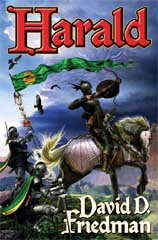
Harald is the debut fantasy novel from David Friedman, libertarian writer and author of The Machinery of Freedom. You can read an excerpt at BAEN Books, publishers of the hardcover edition, due April 2006.
Thursday, December 22, 2005
Adventurous fantasy/sf
I just finished reading a new novel from Scott Mackay, called Tides. Longer review completed and forthcoming in the January edition of Prometheus. This book details the adventures of a mariner driven to sail the vast and treacherous seas that surround his homeworld, in search of a possible other continent. A rollicking sea-tale that also examines clashing cultures, and questions the status quo of an apparent peaceful yet corrupt society.
Longer review completed and forthcoming in the January edition of Prometheus. This book details the adventures of a mariner driven to sail the vast and treacherous seas that surround his homeworld, in search of a possible other continent. A rollicking sea-tale that also examines clashing cultures, and questions the status quo of an apparent peaceful yet corrupt society.
In the mail
I received a copy of the American edition of Justina Robson's Silver Screen. Alas, the UK cover looks far cooler than the Pyr edition. I've just started the book, with plans to review it in neither the January or April edition of Prometheus. So far I am very impressed by the story and writing.
I've just started the book, with plans to review it in neither the January or April edition of Prometheus. So far I am very impressed by the story and writing.
Writer fined for 'Turkish insult'
Another writer fined for Turkish insult against the state. Zulkuf Kisanak's novel describes the forced evacuation of Turkish Kurds from their villages. How can Turkey expect to join the EU with these illiberal laws?
Resurrection of Liberty
I'm working on a long review for Prometheus, but if you like adventurous science fiction that takes you back to the days of Robert A. Heinlein, Michael L. Wentz's novelResurrection of Liberty is on sale for under $20. I really enjoyed this book, and highly recommend it. It's hard to beat this price for a nicely bound hardcover book, and would make a great gift to youngsters and adults alike.
Wednesday, December 21, 2005
L. Neil Smith's movie treat(ment)
Over the Libertarian Enterprise, novelist and Prometheus Award winner L. Neil Smith shares a movie treatment he wrote called TimePeeper. Written in the 1980s, it's an interesting addition to Smith's North American Confederacy universe.
Monday, December 19, 2005
Master and Margarita to debut as TV movie in Russia
The New York Times writes about a nearly nine hour TV movie version of a superb Russian novel, Mikhail Bulgakov's Master and Margarita. "For the Soviet or Russian person, meeting with Bulgakov's novel in 1966 was a taste of freedom," states the director. The book can be read on many levels, one of which details how people "disappear" into the basements of the KGB. Other elements are more fantastic, such as the Devil setting up shop in Moscow. The novel is a hallmark of wit and elebance, but devilishly difficult to adapt to the screen. I seriously hope this gats translated and shown outside Russia one day.
Thursday, December 15, 2005
Turkish novelist on trial for speech
I heard about the case of Orhan Pamuk's trial on NPR driving home today. The trial begins on December 16. Here is a country's most famous novelist on trial for saying something that insults the national character. Apparently, by discussing the verboten subject of over one million alleged Armenian deaths in Turkey in 1915, Pamuk stepped on the toes of Turkish national honor. It's a shame that so many of his countryfolk hate him for daring to speak his mind, but Turkish children are taught at an early age to venerate all things Turkish, and that means no criticism of the government view. Whether or not one million Armenians died should be investigated fully, not swept under the carpet.
Tuesday, December 13, 2005
V for Vendetta teaser

Wally Conger passes on some positive comments from a pre-screening report of V for Vendatta in Austin, Texas recently. Interestingly, the guys at Ain't It Cool News, which posted the comments, wrote early on about disturbing changes to the script. Either the movie changed, or the opinions did, but regardless this does appear positive. The posters are superb.
Monday, December 12, 2005
I'll buy one of these
The death of book publishing? Perhaps. Certainly the device mentioned in this article makes the case well, and merges more than just a book reader into the package. Imagine curling up on a sofa reading a favorite author while listening to music from the same small gadget. Oh yeah!
Historical fiction and liberty
Edward Cline's Sparrowhawk books seem like a compelling series. Book five now available via Laissez Faire Books.
Sunday, December 11, 2005
Can't wait
F. Paul Wilson's new Repairman Jack novel, Harbingers, inches closer to publication. Gauntlet Press released a teaser page with the book cover, a stunning work of art. They begin taking orders on January 1, 2006, and their limited edition probably will sell out before the publication date of June. Mass market hardcover follows later in the year, but hard-core fans will want their copy early.
Wednesday, December 07, 2005
Regional literature
Over at lewrockwell.com, a libertarian site that also at times embraces confederacy southron culture and its implied racism and agrarian aristocracy, Gail Jarvis present a Christmas list of southern American fiction.
Meanwhile, a different sort of culture emerges in Tom Palmer's reading of Ole Edvart Rølvaag’s novel Giants of the Earth. According to Palmer, Giants in the Earth "is about accomplishment, rivalry (of various sorts), the joy of productive work, family, love, religion, common sense, and, above all else, striving."
All this is a far cry from the so-called Southern scenario, where on a frivolous level "beautiful women [are] eagerly sought after by men," and "young Southern aristocrats [try] to win the affection of their true loves during Charleston’s holiday season." Also discussed are more serious issues in the "agrarian South" of " conflicts arising when urbanism creeps into rural communities," and where there are "strange yet kindly master[s]."
Both Rølvang and the southern authors mentioned by Jarvis deal with non-urban settings, but in terms of cultural ideas it seems you have to look to a Norwegian to express the ideas of true American values. Jarvis fails to mention my all-time favorite novel, and a book written by a person from the south Harper Lee's To Kill a Mockingbird. Perhaps this book is too famous, or contains the wrong values, as Jarvis seeks to highlight works that "avoid the stereotypical Hollywood clichés about the region."
Meanwhile, a different sort of culture emerges in Tom Palmer's reading of Ole Edvart Rølvaag’s novel Giants of the Earth. According to Palmer, Giants in the Earth "is about accomplishment, rivalry (of various sorts), the joy of productive work, family, love, religion, common sense, and, above all else, striving."
All this is a far cry from the so-called Southern scenario, where on a frivolous level "beautiful women [are] eagerly sought after by men," and "young Southern aristocrats [try] to win the affection of their true loves during Charleston’s holiday season." Also discussed are more serious issues in the "agrarian South" of " conflicts arising when urbanism creeps into rural communities," and where there are "strange yet kindly master[s]."
Both Rølvang and the southern authors mentioned by Jarvis deal with non-urban settings, but in terms of cultural ideas it seems you have to look to a Norwegian to express the ideas of true American values. Jarvis fails to mention my all-time favorite novel, and a book written by a person from the south Harper Lee's To Kill a Mockingbird. Perhaps this book is too famous, or contains the wrong values, as Jarvis seeks to highlight works that "avoid the stereotypical Hollywood clichés about the region."
Catastrophes, Chaos & Convolutions
Available now, the latest James Hogan collection. I'm hoping to review this in the January edition of Prometheus, but I'm behind already on writing some other reviews, so it might be later.
. I'm hoping to review this in the January edition of Prometheus, but I'm behind already on writing some other reviews, so it might be later.
Friday, December 02, 2005
Rudyard Kipling Invented SF!
Eric S. Raymond is spurred to further reading on Kipling by a comment on his essay that I reprinted in Prometheus. I have to admit that it's been a long time since I read Kipling, and then it mostly was his Indian tales. I've pulled down my Kipling sf collection and hope to read the stories again, given the comments by both Raymond and William Stoddard, who caused Raymond to re-think some of the ideas in his original essay.
Wednesday, November 30, 2005
Calling card
I'm travelling this week, hence the lack of posts. I had hoped to post a couple of book reviews, but these are still in process. In the meantime, as I'm sorting through my luggage preparing for my return flight, I notice a strange card. It appears the Transportation Security Aministration's minions opened my checked in luggage, pawed through the contents, and left me a card explaining what they did. There's no indication why, although I did put part of my keychain in this bag, since it includes a tiny Swiss Army knife, and I did not want it confiscated. Next time I'll leave that implement in the car, and carry the extra luggage on the plane. And I used to like airports and flying. No more. I'm tired of the long lines, the bored yet superior attitude of the screeners, and the waste and fraud the accompany any federalized operation.
Monday, November 28, 2005
Ayn Rand and sf
Roderick T. Long relates a personal search for an elusive memory of an article on Ayn Rand and science fiction in an old issue of Starlog. The issue in question, #22, May 1979 contains an article on the science fiction of Ayn Rand, especially Anthem and Atlas Shrugged, and includes a Boris Vallejo painting of the John Galt torture scene from the latter novel. The link in Long's article about a movie adaptation of Anthem takes the surfer to an article from early 2004. Posted by Rand scholar Chris Sciabarra this story talks about former Starlog publisher Kerry O'Quinn acquiring the movie rights to Anthem. I personally think the book would better be adapted as a graphic novel or animated movie, filmed purely in black and white. Still, Rand fans whose interest is piqued by this story may drive the price of that 26 year old issue of Starlog.
Tuesday, November 22, 2005
Book received: John Meaney

Next week I'm hoping to complete three long book reviews for Prometheus, the newsletter that I edit. Lo and behold, Pyr books drops a large, heavy volume at my doorstep, which I look forward to reading but will have to wait until those prior obligations are finished. John Meaney's Context
looks quite interesting. In interview at SF Site from 2002, conducted by Lou Anders, British sf writer Meaney talks about his novel. There's a dark force rising throughout Nulapeiron, known as the Blight, or the Dark Fire. It subsumes human beings, makes them insignificant components of a vast whole: an entity which bears the same relationship to a single human being as a person does to a bacterium. From small beginnings, realms undergo strange societal changes, until they become part of the Blight-occupied territories.
The US publication date is 2005. It's book two of a series, but the author promises each will work as a stand-alone book. Fantastic over painting by Jim Burns. More to follow...
Harry Potter and the Half-Crazed Bureaucracy
Via Liberty and Power, a link to an abstract of an essay by Benjamin Barton on the implied libertarian critique of government in J. K. Rowling's Harry Potter novels.
I ventured reluctantly into the world on Harry Potter only after the third novel saw publication in paperback, but I quickly became a fan. The seven-novel saga (one book remains to be written) sketches a rich world as young Harry grows to adulthood, cursed to be different in many ways. He's a wizard, an orphan, abused by his adoptive family, feared and misunderstood by fellow wizards, and fated to face the most dangerous wizard ever born. I noticed early on the strong antipathy towards government and its minions in Rowling's books, especially book five. Yet also the man-hunt for Sirius Black and revelations into the way the Ministry of Magic dealt with wizards after Voldemort's "death" highlighted the corruption of those in power. Several of Voldemort's allies received government positions, influencing the direction of the Ministry. For an alleged children's series, Harry Potter is layered with multiple meanings far beyond the perceptions of a young audience. Rowling writes with this in mind, resulting in the series' popularity with adults as well.
The critique is even more devastating because the governmental actors and actions in the book look and feel so authentic and familiar. Cornelius Fudge, the original Minister of Magic, perfectly fits our notion of a bumbling politician just trying to hang onto his job. Delores Umbridge is the classic small-minded bureaucrat who only cares about rules, discipline, and her own power. Rufus Scrimgeour is a George Bush-like war leader, inspiring confidence through his steely resolve. The Ministry itself is made up of various sub-ministries with goofy names (e.g., The Goblin Liaison Office or the Ludicrous Patents Office) enforcing silly sounding regulations (e.g., The Decree for the Treatment of Non-Wizard Part-Humans or The Decree for the Reasonable Restriction of Underage Sorcery). These descriptions of government jibe with our own sarcastic views of bureaucracy and bureaucrats: bureaucrats tend to be amusing characters that propagate and enforce laws of limited utility with unwieldy names. When you combine the light-hearted satire with the above list of government activities, however, Rowling's critique of government becomes substantially darker and more powerful.
I ventured reluctantly into the world on Harry Potter only after the third novel saw publication in paperback, but I quickly became a fan. The seven-novel saga (one book remains to be written) sketches a rich world as young Harry grows to adulthood, cursed to be different in many ways. He's a wizard, an orphan, abused by his adoptive family, feared and misunderstood by fellow wizards, and fated to face the most dangerous wizard ever born. I noticed early on the strong antipathy towards government and its minions in Rowling's books, especially book five. Yet also the man-hunt for Sirius Black and revelations into the way the Ministry of Magic dealt with wizards after Voldemort's "death" highlighted the corruption of those in power. Several of Voldemort's allies received government positions, influencing the direction of the Ministry. For an alleged children's series, Harry Potter is layered with multiple meanings far beyond the perceptions of a young audience. Rowling writes with this in mind, resulting in the series' popularity with adults as well.
Subscribe to:
Posts (Atom)


 Posts
Posts

