Television. I hardly watch any more. First, I never have time. Then, there's the glaring lack of quality, except on premium channels like HBO, which doesn't need to stay within the FCC's lines. And yet, there's always the rage about 'reality' shows, laugh-track 'comedy,' and the corpse-fetish shows like CSI, or the current hot drama where the audience is as lost as the cast members. No doubt my tastes are too narrow.
A few people I know recommended Heroes, but due to timing I've oly been able to catch the last fifteen minutes of two episodes. I was able to watch 80% of the mid-season finale, and instantly got hooked. I could pay $1.99 for the recap from iTunes, or wait for reruns, but lickly NBC has posted all 11 episodes to date for a limited time. I've watched the first four, and while I don't know how many more I can watch before the freebies are gone, I'm impressed beyond words at this show. I don't know how long the magic can last, for in my opinion TV shows rarely sustain greatness beyond a couple of seasons, before writers get desparate for attention, and the worm eats itself.
I recently read an essay on lewrockwell.com expounding an 'Austrian' theory of culture, with which I have many, many disagreements. I am mulling over a reply and my own theory. The gist of this essay is the author's embrace of TV as good culture, especially long-lasting shows and collaborative efforts (Gilligan's Island, X-Files, and The Simpsons are the author's favorites). I don't know about the writers of Heroes, of the long-term plan of the show, but were only to last one season, say 22 episodes, that might be a better thing than drag on for five years. There are well-written shows on TV now and in the past where cast members solve things week after week, but a few hours after the show is over you've forgotten everything. Heroes instead layers question after question, with multiple story-arcs, and leaves me wondering after each one what will happen. In some sense I already know, as I read every word at the Wikipedia site, which is rife with spoilers. Perhaps I should have waited until after I saw the shows, but I didn't think I would have that chance until several months from now with re-runs. Heroes is like a well-written novel, and indeed every show is entitled "Chapter X" (with a number instead of X), much like a novel. Perhaps it's the geek in my, but the thread with Hiro Nakamura is my favorite. I almost wish the show was a long book, as so far this is the most novel like TV show I've ever seen.
Saturday, December 30, 2006


Wednesday, December 27, 2006
Another day, another 1800 words written. I'm actually shocked and surprised how little use I've made of my copious notes that I prepared while listening to the three Heinlein audio plays I'm reviewing for Prometheus. Perhaps I'd use more if I didn't have certain space constraints, but then quite a bit of the notes are just there to remind me of what I heard. I did manage to re-locate today the web page that has all episodes of Dimension X available as mp3 files. I researched the show a couple of years ago while planning this review, as well as the follow-up, X Minus One. The download time from their FTP server is horrible, but I hope it's worth the effort. Only 500 more words to go before this review essay is done, and then three page remain left to fill. Luckily, two of those pages have other stuff already in place, so it's more like two pages and a dash. Come January I'll be buried in books trying to make some headway through the dozen plus review copies received in 2006. And that doesn't begin to count the books that I want to read. I've gone to find a more forgiving habit...
Tuesday, December 26, 2006
It's that time again
As editor of Prometheus, the quarterly newsletter of the Libertarian Futurist Society, I try to stick to a reasonable production schedule. This means that the issues should appear each January, April, July, and October. In order to get the issues out to reader by the middle of those months, I have to get them to the printer sometime in the first week (currently the 5th of each month). I'm now able to play a little with the printer deadline, thanks to reducing my trips there from three to one by emailing the issue as PDF instead of hand delivering the CD and then returning to proof the printed copy and later to pick up the final product. However, this year I've slipped a little almost every month, in large part due to the addition of child number two. The day job is draining enough, but by the time the kids are in bed and the house somewhat restored, the night is late. Unfortunately, I currently don't have as many submissions per issue as I'd like, so I find myself in the position of trying to find the time to read books to review, or conceive of articles to write, and then actually hammer out words that make sense on the keyboard. And believe me, little tends to make sense close to midnight after a long day.
After a couple of efforts at jacking up the page length of the issue to 20, time and lack of original material has brought me back to reality and 12 pages; the year 2007 may see Prometheus fall even further, to eight pages. It's now December 26. My deadline for the January issue looms closer and closer, and only six pages of content are set at the moment. One of those pages I wrote today, but that still means I have six pages to write in one week, then rewrite the pages into somewhat coherent prose, proof and re-read all the pages again. Errors always creep in, sometimes small typos, and sometimes huge gaffes. You'd think, why not space it out over months, instead of fretting at the last minute. The answer is that I have been doing just that, as I needed two months to read the material that makes up my contribution for this issue. I worked under the assumption that I have to create 50-80% of the issue, although I would prefer 0-5%. In order to write one brief review, I've read a long work of fiction, a critical biography, and some other source material. In order to review three audioplays (actually seven, on three CDs), I've spent several hours listening to the works, looked for artwork to accompany the pieces, and jotted notes throughout the process. In order to review another book, I've read several interviews, the book itself and a related novella, and the author's autobiography. Not everything that I read makes it into my reviews, but in the end I find the process necessary. Those digressions often end up quite rewarding as well, but send me down raods quite unrelated to the actually production of the newsletter.
I do find myself wondering if it's all really worth it, though. I've now completed two years in my second stint as editor. I have less time in the past for this sort of stuff, but at least it forces me to write something. I often feel that I might not write anything without a literal gun to my head. Witness this rarely updated blog, where 90% of the time I post only brief, newsy snippets and links. usually, after each is issue is mailed out, there is only silence. I assume most of the issues find their addressees, though one or two come back return to sender. I can only hope for the possibility down the road of more contributors, as I know there are people out there with interesting things to say. But perhaps in the age of blogs and the internet, an old-school print newsletter is just heading down the same road as the dodo.
After a couple of efforts at jacking up the page length of the issue to 20, time and lack of original material has brought me back to reality and 12 pages; the year 2007 may see Prometheus fall even further, to eight pages. It's now December 26. My deadline for the January issue looms closer and closer, and only six pages of content are set at the moment. One of those pages I wrote today, but that still means I have six pages to write in one week, then rewrite the pages into somewhat coherent prose, proof and re-read all the pages again. Errors always creep in, sometimes small typos, and sometimes huge gaffes. You'd think, why not space it out over months, instead of fretting at the last minute. The answer is that I have been doing just that, as I needed two months to read the material that makes up my contribution for this issue. I worked under the assumption that I have to create 50-80% of the issue, although I would prefer 0-5%. In order to write one brief review, I've read a long work of fiction, a critical biography, and some other source material. In order to review three audioplays (actually seven, on three CDs), I've spent several hours listening to the works, looked for artwork to accompany the pieces, and jotted notes throughout the process. In order to review another book, I've read several interviews, the book itself and a related novella, and the author's autobiography. Not everything that I read makes it into my reviews, but in the end I find the process necessary. Those digressions often end up quite rewarding as well, but send me down raods quite unrelated to the actually production of the newsletter.
I do find myself wondering if it's all really worth it, though. I've now completed two years in my second stint as editor. I have less time in the past for this sort of stuff, but at least it forces me to write something. I often feel that I might not write anything without a literal gun to my head. Witness this rarely updated blog, where 90% of the time I post only brief, newsy snippets and links. usually, after each is issue is mailed out, there is only silence. I assume most of the issues find their addressees, though one or two come back return to sender. I can only hope for the possibility down the road of more contributors, as I know there are people out there with interesting things to say. But perhaps in the age of blogs and the internet, an old-school print newsletter is just heading down the same road as the dodo.
Tuesday, December 19, 2006
Grim futures
Reason Magazine writer David Weigel rips into a trio of right-wing fictional dystopias. There appears to be little of interest to libertarians, but it's interesting to see how all the talk on right-wing radio and blogosphere about culture wars is leaking into fiction. I'm glad a libertarian writer like Weigel has made a pre-emptive strike on these books, as I am sure that somewhere, somehow, some critics will lump these books and writers into the "libertarian sf" camp.
Monday, December 18, 2006
Piper Gutenberged
Via the RSS feed from SFSignal, news that H. Beam Piper's awarding winning novel, Lone Star Planet is available online at the Gutenberg Project. Nice effort, though I question the people at Gutenberg's statement that this work is not copyrighted in the US. Piper died 40 years, so he doesn't need the income, and his book is online for free, but I was under the impression Piper's copyright still was held by someone. Perhaps my information is outdated.
Monday, December 11, 2006
The Mount
One of the several books that I'm currently reading is a curious novel by Carol Emshwiller, called The Mount. The version that I have was published in 2002 by Small Beer Press. It received a Nebula nomination for best novel in 2003, and won the Philip K. Dick Award that year. Emswhiller's style flirts with postmodern/slipstream methods, meaning for me it takes a while to adapt to the novel and writer. The Mount deals with a future Earth enslaved by small creatures called Hoots who enslave and ride people as beast of burden. I'm only a few pages into the book, which I picked up by chance at World Fantasy Con in November, yet already I wonder if this was a Prometheus Award nominee in 2003. So far it certainly fits the typical nominee profile (as much as there is one), but I shall have to see where the book leads. Emshwiller's been writing for decades, but is one of the many names so far that I've just missed, as there are now so many books published each year in sf.
The expanding Firefly 'verse
From Wired magazine, word that soon you will be able to inhabit the vrtual world of the Serenity crew. No word on the timeline or whether you can play a reaver, but part of me wonders, "enough already." I guess I'm not a browncoat, as I tru;y enjoyed both the TV episodes and the movie, but beyond that am unwilling to commit myself to that world. Then again, I'm not a serious games, played Warcraft when it first came out as a solo game and against one other person on a local network, and prefer the virtual world between the pages of a good book. MMORPGs may be the future of gaming, just as social sites like MySpace may be the future of the web. In that case, I'm a dead-end branch on the vast electronic tree of the future.
Sunday, December 10, 2006
L. Neil Smith interview
Colorado Freedom Report has a new interview with Prometheus Award-winning author, L. Neil Smith, dated December 7.
Tuesday, November 28, 2006
I've been busy the past few weeks reading books from a different time. Or is that different times. I finished re-reading Sinclair Lewis' 1935 novel It Can't Happen Here, and am working my way through the 1961 biography written by Mark Schorer, which is far from kind. I'm in the middle of writing my brief introduction to my strangest review format yet, in sonnet form, of Lewis' novel.
I also finished last night a book that's long been on my list to read, Jack Williamson's The Humanoids, first published in short story form in 1947 as "With Folded Hands." (I am delighted to discover that my unread copy of Pulphouse Publishing's Author's Choice Monthly Issue 5 - Jack Williamson (1990) contains this story.) Somewhere in my library I also have the sequel, The Humanoid Touch, which is now on my must-read list. The former novel has been nominated twice for the Libertarian Futurist Society's Hall of Fame award, yet I don't believe it's ever been a finalist. That's a shame, as for at least the first 4/5th of the novel I was riveted by the action and plot, and the novel far exceeded my expectations. The conclusion surprised me, and left me wondering about the author's intentions. I have a somewhat ambiguous view of Williamson's fiction. On the one hand, he was a giant in the field of sf. He died a couple of weeks ago at age 98, and continued to teach and write virtually to the end. Yet I have read very few of his books. I tried a few years ago to read his then new novel, The Silicon Dagger, but I don't think I finished it. His story in the recent Baen collection Visions of Liberty, "Devil's Star," was in my opinion the worst of the lot. I wasn't sure if the style was deliberately pulp, or if Williamson eschewed style for straight two-fisted prose. On the other hand, his politics seem influenced by libertarian ideas, as he stated in this interview from 1999. I wanted to see how those ideas influenced his fiction. Yet my experience with the two works I mentioned prevented me from reading more of Williamson's work, until his name came up again during a conversation I had in early November at the World Fantasy Con in Austin, Texas. Sadly, not two days after I started reading The Humanoids I read the news that Williamson died. I've nominated this book again for the LFS Hall of Fame, and intend to write a review in the January issue of Prometheus.
Although unrelated to the purpose of this blog, I'm currently reading The Selected Letters of Clark Ashton Smith. Smith is probably my second favorite writer after Jack Vance, and a superb poet as well. The book is at times fascinting, mundane, sad, and illuminating. I wish I could afford the earlier Arkham House editions of his works, but instead I have to wait for newer and cheaper editions.
A current writer who deserves greater acclaim is John C. Wright, whose first published novel, The Golden Age could have, should have won the Prometheus Award for best novel in 2003. His latest novel appeared in bookstores last week. His regularly updated Livejournal blog contains many intersting discussions and thoughts. Wright recently converted from atheism to Christianity, which influences quite a few of his posts. As a non-militant atheist I have yet to read anything that will convert me to any theism, but he's a damn good fiction writer.
I also finished last night a book that's long been on my list to read, Jack Williamson's The Humanoids, first published in short story form in 1947 as "With Folded Hands." (I am delighted to discover that my unread copy of Pulphouse Publishing's Author's Choice Monthly Issue 5 - Jack Williamson (1990) contains this story.) Somewhere in my library I also have the sequel, The Humanoid Touch, which is now on my must-read list. The former novel has been nominated twice for the Libertarian Futurist Society's Hall of Fame award, yet I don't believe it's ever been a finalist. That's a shame, as for at least the first 4/5th of the novel I was riveted by the action and plot, and the novel far exceeded my expectations. The conclusion surprised me, and left me wondering about the author's intentions. I have a somewhat ambiguous view of Williamson's fiction. On the one hand, he was a giant in the field of sf. He died a couple of weeks ago at age 98, and continued to teach and write virtually to the end. Yet I have read very few of his books. I tried a few years ago to read his then new novel, The Silicon Dagger, but I don't think I finished it. His story in the recent Baen collection Visions of Liberty, "Devil's Star," was in my opinion the worst of the lot. I wasn't sure if the style was deliberately pulp, or if Williamson eschewed style for straight two-fisted prose. On the other hand, his politics seem influenced by libertarian ideas, as he stated in this interview from 1999. I wanted to see how those ideas influenced his fiction. Yet my experience with the two works I mentioned prevented me from reading more of Williamson's work, until his name came up again during a conversation I had in early November at the World Fantasy Con in Austin, Texas. Sadly, not two days after I started reading The Humanoids I read the news that Williamson died. I've nominated this book again for the LFS Hall of Fame, and intend to write a review in the January issue of Prometheus.
Although unrelated to the purpose of this blog, I'm currently reading The Selected Letters of Clark Ashton Smith. Smith is probably my second favorite writer after Jack Vance, and a superb poet as well. The book is at times fascinting, mundane, sad, and illuminating. I wish I could afford the earlier Arkham House editions of his works, but instead I have to wait for newer and cheaper editions.
A current writer who deserves greater acclaim is John C. Wright, whose first published novel, The Golden Age could have, should have won the Prometheus Award for best novel in 2003. His latest novel appeared in bookstores last week. His regularly updated Livejournal blog contains many intersting discussions and thoughts. Wright recently converted from atheism to Christianity, which influences quite a few of his posts. As a non-militant atheist I have yet to read anything that will convert me to any theism, but he's a damn good fiction writer.
Wednesday, November 08, 2006
The Weapon Shops audioplay
I learned yesterday via email that the audioplay production of A.E. van Vogt's story, "The Weapons Shops," has been completed. Apparently it already premiered this Summer at Dragon*Con (scroll down half-way for a group photo) this year in Atlanta, and also played at a frefan party at the WorldCon in Los Angeles. Adapted by Brad Linaweaver and featuring Richard Hatch of Battlestar Gallactica fame (the original series), the CD is not yet available on the home site of the Atlanta Radio Theatre Company. The short story itself, however, can be found in Baen Books' onmibus collection Freedom! which combined all the stories previously gathered under Give Me Liberty and Visions of Liberty. These two collections won a Special Award in 2005 from the Libertarian Futurist Society. "The Weapon Shops" is a classic of libertarian sf, and along with Vernor Vinge's "The Ungoverned" and Eric Frank Russell's "And Then There Were None" stand as the best pieces in that book. I already bought the three Heinlein audioplays from ARTC, and so far have enjoyed "The Man Who Travelled in Elephants" via my iPod. This CD transferred quite nicely, with each track titled and clear. The other two CDs must not have been loaded into the database that iTunes checks, as all the tracks say "untitled." I suppose I will need to update these manually. Listening to the story adds a different dimension to appreciating them as works of fiction, and at ca. 30 minutes does not demand too much of your time. I saw ARTC perform live back in 1995, and you can almost visualize them from the audio alone.
Monday, November 06, 2006
Simple syndication? Really?
A couple of people have mentioned the lack of RSS on this blog. Today I attempt to remedy this deficiency. I moved to Blogger Beta, enabled site feed options, and added the link for readers to subscribe to this blog. If you try this out, please let me know if it works, or if nothing happens. I confess to having tried out RSS months ago, but it didn't seem to be simple at that time, or perhaps I lacked the patience to follow all the necessary steps.
Sunday, November 05, 2006
World Fantasy Con
Back from four days at World Fantasy Con in Austin, Texas. No email or internet activity for the duration of my stay. Bought a few too many books, lusted for several others just too pricey for me at the moment, and generally tried to relax. I'm not a gregarious person, and knew very people, so I spent most of my time in the dealers' room. Drove around Austin for a while as well, and much has changed since I moved away five years ago. I sat in on a few panels, but found only one worthwhile. I've attended a handful of WorldCons, one DragonCon, half a dozen local Austin cons -- ArmadilloCon -- but this was my worst sf con experience in 18 years. Maybe it's typical for WFC. I don't know. The panel track was anemic and poorly organized. On one panel an individual said a total of ten words and wondered out loud why the hell he was there to begin with, and often the moderators struggled for direction. Only panel I enjoyed included Tim Powers and a well-spoken David Drake.
Anyway, I achieved my main goal for attending, and that was to meet F. Paul Wilson in person and get my FPW hardcover books autographed. I hauled a huge bag full of 20+ hardcovers to the one, big signing on Friday night, and he signed them all. I guess next time I'll bring all my anthologies and paperbacks, otherwise I would have needed a cart to haul them around. I also got my more recent Tim Powers acquisitions signed, including three versions of the same book. There were other writers there whose books I could have gotten signed, but there was a limit to how much I could carry. The dealers room seems small, though full of modern and rare works. It's staggering to see the prices on some of the older books, even from a couple of decades ago. I saw none of these sell while there, so I wonder how the dealers make money. I did see a lot of current books being bought, but at least one table kept marking down stuff more and more each day.
Now, if only those Clark Ashton Smith books from Arkham House weren't so damned expensive...
Anyway, I achieved my main goal for attending, and that was to meet F. Paul Wilson in person and get my FPW hardcover books autographed. I hauled a huge bag full of 20+ hardcovers to the one, big signing on Friday night, and he signed them all. I guess next time I'll bring all my anthologies and paperbacks, otherwise I would have needed a cart to haul them around. I also got my more recent Tim Powers acquisitions signed, including three versions of the same book. There were other writers there whose books I could have gotten signed, but there was a limit to how much I could carry. The dealers room seems small, though full of modern and rare works. It's staggering to see the prices on some of the older books, even from a couple of decades ago. I saw none of these sell while there, so I wonder how the dealers make money. I did see a lot of current books being bought, but at least one table kept marking down stuff more and more each day.
Now, if only those Clark Ashton Smith books from Arkham House weren't so damned expensive...
Tuesday, October 31, 2006
Hungary 50 years ago
With the 50th anniversary of the Hungarian uprising against Soviet rule, a review essay in the New York Times on three books detailing events in 1956. Of interest is the reation and inaction of the American government at the time, and the bungled CIA analysis. It's amazing that spy agencies currently get $45 billion a year, and have learned nothing.
Monday, October 30, 2006
Sinclair Lewis
I'm currently re-reading a classic work of fiction, Sinclair Lewis' 1935 novel, It Can't Happen Here. Now possibly out of print (although the NAL edition from 2055 seems available at Amazon), the book deals with the rise of fascism in America in the 1930s, propelled by a populist senator who runs for president. The senator's supporters include the fictional Bishop Prang, who holds forth from his own radio station preaching a raging form of national socialism no different from that found in Germany and Italy at the time. Yet along for the ride is the whole spectrum of the American public and every vocation in the land. Only a few stand against this tide of boorish, brutish, collectivist ideology.
My own copy I bought in 1986 at a used bookstore in Bergen, Norway, for the princely sum of 60 kroner. As I had no money at the time, those $10 meant a lot to me. Sadly, I remember little of the book, for as I read it now I am struck with the lucid prose and Cassandra-like warnings in the book. Lewis, from what I have read, seems both critical of capitalism and socialism (as they were seen back then), and became the first American to win the Nobel Prize in literature (1930).
My own copy I bought in 1986 at a used bookstore in Bergen, Norway, for the princely sum of 60 kroner. As I had no money at the time, those $10 meant a lot to me. Sadly, I remember little of the book, for as I read it now I am struck with the lucid prose and Cassandra-like warnings in the book. Lewis, from what I have read, seems both critical of capitalism and socialism (as they were seen back then), and became the first American to win the Nobel Prize in literature (1930).
Thursday, October 19, 2006
Why do libertarians love science fiction?
An old post from Tyler Cowen about this strange link. The comments make for interesting reading. Join the debate..
Sunday, October 15, 2006
Prometheus at the printer
It never fails. The newsletter is 99% done, and then I have to spend two weeks taking full care of a six-month old and four-year old as my spouse is off defending a client in a law-suit. I don't think I ever appreciated the amount of work that single parents shoulder every day, especially when it comes to very small kids. Far from having any time to complete the newsletter, I ended up every day mentally and physically exhausted. But now, the issue has been delivered to the printer, and in a few days should be in the mail to members and subscribers.
I've already listed the contents in a previous entry, and I've started work on the January 2007 issue as well. I ordered three CDs from the Atlanta Radio Theatre Company, all Heinlein adaptations, to review as a package deal. I know there'll be at least one more order soon, as I believe they're adapting A.E. van Vogt's "The Weapon Shops of Isher." I'm also laying the groundwork for my strangest review yet, a 14-line sonnet on Sinclair Lewis's novel, It Can't Happen Here. I read the book once in 1986 (I believe the book is the first British edition from 1936, or it may be an imprint from that edition). The reason for this format, and the title of the sonnet, derive from my literary hero, John Keats, and a poem he wrote on re-reading King Lear. It's vanity, I know, but I've had this idea in my mind for several years, and I finally dug up my copy of the book and started to read it and jot down notes. I haven't written poetry in many years, so who knows how it turns out.
Other items scheduled for review include Justina Robson's Mappa Mundi, and a few other books from my review copies shelf. I'm currently reading Brad Linaweaver's political broadside, so again there will be some non-fiction reviews in the newsletter.
If you're reading this and have any reviews of article you'd like to see in print, please send me an email at editor@lfs.org.
I've already listed the contents in a previous entry, and I've started work on the January 2007 issue as well. I ordered three CDs from the Atlanta Radio Theatre Company, all Heinlein adaptations, to review as a package deal. I know there'll be at least one more order soon, as I believe they're adapting A.E. van Vogt's "The Weapon Shops of Isher." I'm also laying the groundwork for my strangest review yet, a 14-line sonnet on Sinclair Lewis's novel, It Can't Happen Here. I read the book once in 1986 (I believe the book is the first British edition from 1936, or it may be an imprint from that edition). The reason for this format, and the title of the sonnet, derive from my literary hero, John Keats, and a poem he wrote on re-reading King Lear. It's vanity, I know, but I've had this idea in my mind for several years, and I finally dug up my copy of the book and started to read it and jot down notes. I haven't written poetry in many years, so who knows how it turns out.
Other items scheduled for review include Justina Robson's Mappa Mundi, and a few other books from my review copies shelf. I'm currently reading Brad Linaweaver's political broadside, so again there will be some non-fiction reviews in the newsletter.
If you're reading this and have any reviews of article you'd like to see in print, please send me an email at editor@lfs.org.
Thursday, October 12, 2006
Pamuk Wins Nobel in Literature
Orhan Pamuk, a Turkish writer who does not shy away from confronting the Turkish government, won the 2006 Nobel Prize in literature. Much has been made recently of non-Western writers daring to critique their own culture, such as Naguib Mafouz, Salman Rushdie, Parviz Parvizian, Elif Shafak, and many, many more. The pen is as feared as the sword, even relatively calm works are excoriated without being read, subjected to the "the tics and manias of obscurantism."
Thursday, October 05, 2006
The Probability Broach for free
The graphic novel, that is. In case you didn't shell out cash for the excellent print version, as of Oct 4, Big Head Press is serializing L. Neil Smith's novel (drawn by Scott Bieser) online for free.
Wednesday, October 04, 2006
Robert Anton Wilson Needs Our Help
Douglas Rushkoff posts distressing news about the great Robert Anton Wilson, author of many brilliant books including the Illuminatus! trilogy. I corresponded briefly with Wilson ten years ago and was impressed with his kindness, wit, and intelligence.
Saturday, September 30, 2006
Prometheus covers
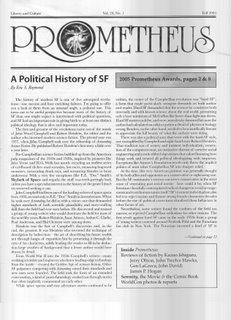
My vision of Prometheus as a newsletter features cool cover art with cutting edge articles and reviews within. I don't always get artwork for the cover, and as you can see from these three samples sometimes the newsletter leads off with the article on the front page.

When L. Neil Smith's novel, The Probability Broach was published as a graphic novel in early 2005, I immediately asked Neil and artist Scott Bieser for permission to reprint some of the art in the issue. They agreed, and so I took advantage or their generosity. The last page of the newsletter contains a small frame of the delectable DJ Thorens, and I wrote a review of the graphic novel version. I've now actually bought more graphic novels since 2004 than between 1990 and 2004, but I can still count them on two hands. My personal opinion is that the graaphic novel version of TPB should have been a best novel nominee, but instead the book won as a Special Award. It probably would not have won as a novel, since it already won back in 1982.
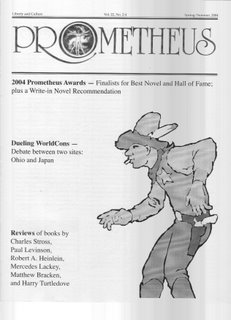
The issue with the gunslinger and was inspired by the two articles for each WorldCon site. This issue almost never appeared in print. In 2004 there was a transition in editorship for the newsletter, and this issue was sent to members in two emails. this was around the time I thought about volunteering to help edit the issue, and so I created a sample newsletter to sort of see if I actually could put together an issue again. I had already moved from OS 9 on the Mac to OS X, and my PageMaker software no longer ran native. So, I upgraded to InDesign 2, and threw together an issue and learned a few things about the software. I never released this issue to anyone, and almost lost all the electronic bits in a hardware crash. When I recovered the drive and after I already had put out a couple of issues, I redisovered this 2004 print version, and decided to release it as a special issue.
And here is a plain, almost vanilla cover. A few of the most recent issues have gone 16-20 pages, and with page real estate in these issues at a premium I decided to skip creating a distinctive cover. The current issue again features artwork on the cover, but I'll hold off on posting this until after the issue is published, some time in mid-October. The issues shown on this page are all available for $3 (just send me an email for details), or you can join LFS and receive each forthcoming issue per year of your membership. A few years ago I had several complete sets of all the back issues of Prometheus, but now there are quite a few that I lack, especially for issues prior to 2004. If anyone knows how to scan pages into PDF, please let me know and I can start the process to put all the back issues online at some point.
By the way, I'm always looking for articles and reviews for the newsletter. Please contact me for details.
As a preview, here's what's in store for members and subscribers in the Fall 2006 issue:
Inside Prometheus:
Prometheus Award winners’ remarks from David Lloyd, Patrick Nielsen Hayden (editor), and Ken MacLeod
WorldCon Report by Fred Curtis Moulton with photos of the event
A brief review of the movie version of V for Vendetta
Fiction reviews:
F. Paul Wilson's The Keep: The Graphic Novel
Gary Bennett's The Star Sailors, a 1982 novel recently available again
Keith Brooke's Genetopia
David Louis Edelman's Infoquake
A trio of Naomi Novik books reviewed
Ian MacDonald The River of Gods
Chris Roberson's Paragaea
David Lloyd’s Kickback

When L. Neil Smith's novel, The Probability Broach was published as a graphic novel in early 2005, I immediately asked Neil and artist Scott Bieser for permission to reprint some of the art in the issue. They agreed, and so I took advantage or their generosity. The last page of the newsletter contains a small frame of the delectable DJ Thorens, and I wrote a review of the graphic novel version. I've now actually bought more graphic novels since 2004 than between 1990 and 2004, but I can still count them on two hands. My personal opinion is that the graaphic novel version of TPB should have been a best novel nominee, but instead the book won as a Special Award. It probably would not have won as a novel, since it already won back in 1982.

The issue with the gunslinger and was inspired by the two articles for each WorldCon site. This issue almost never appeared in print. In 2004 there was a transition in editorship for the newsletter, and this issue was sent to members in two emails. this was around the time I thought about volunteering to help edit the issue, and so I created a sample newsletter to sort of see if I actually could put together an issue again. I had already moved from OS 9 on the Mac to OS X, and my PageMaker software no longer ran native. So, I upgraded to InDesign 2, and threw together an issue and learned a few things about the software. I never released this issue to anyone, and almost lost all the electronic bits in a hardware crash. When I recovered the drive and after I already had put out a couple of issues, I redisovered this 2004 print version, and decided to release it as a special issue.
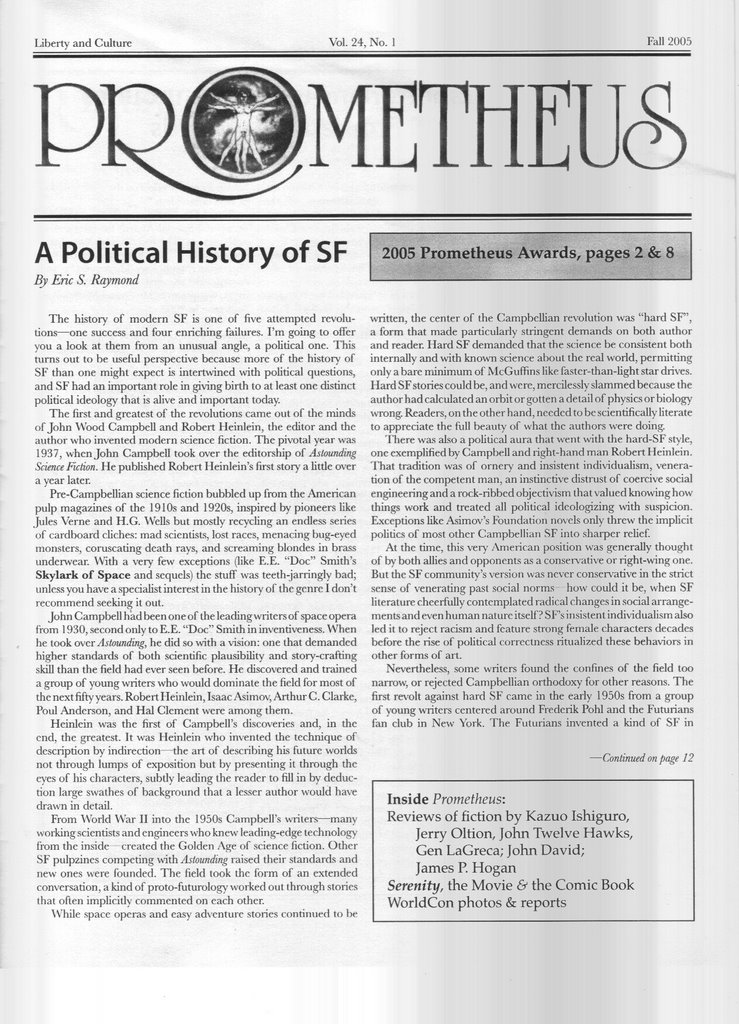
And here is a plain, almost vanilla cover. A few of the most recent issues have gone 16-20 pages, and with page real estate in these issues at a premium I decided to skip creating a distinctive cover. The current issue again features artwork on the cover, but I'll hold off on posting this until after the issue is published, some time in mid-October. The issues shown on this page are all available for $3 (just send me an email for details), or you can join LFS and receive each forthcoming issue per year of your membership. A few years ago I had several complete sets of all the back issues of Prometheus, but now there are quite a few that I lack, especially for issues prior to 2004. If anyone knows how to scan pages into PDF, please let me know and I can start the process to put all the back issues online at some point.
By the way, I'm always looking for articles and reviews for the newsletter. Please contact me for details.
As a preview, here's what's in store for members and subscribers in the Fall 2006 issue:
Inside Prometheus:
Prometheus Award winners’ remarks from David Lloyd, Patrick Nielsen Hayden (editor), and Ken MacLeod
WorldCon Report by Fred Curtis Moulton with photos of the event
A brief review of the movie version of V for Vendetta
Fiction reviews:
F. Paul Wilson's The Keep: The Graphic Novel
Gary Bennett's The Star Sailors, a 1982 novel recently available again
Keith Brooke's Genetopia
David Louis Edelman's Infoquake
A trio of Naomi Novik books reviewed
Ian MacDonald The River of Gods
Chris Roberson's Paragaea
David Lloyd’s Kickback
Subscribe to:
Posts (Atom)


 Posts
Posts

